Home Blog Page 97

Anand and Kasparov set for 12-round Chess960 clash, Carlsen-Gukesh faceoff also likely

0
Viswanathan Anand
Viswanathan Anand

Viswanathan Anand and Garry Kasparov will reignite their historic rivalry this October in a special 12-game Chess960 showdown titled ‘Clutch Chess’. Set to take place at the newly revamped St. Louis Chess Club campus, the event marks a major highlight in the club’s grand reopening celebrations.

Alongside their duel, a high-stakes rapid tournament is also scheduled, featuring top-tier names like Magnus Carlsen, Hikaru Nakamura, Fabiano Caruana, and rising star D Gukesh.

The Anand-Kasparov faceoff is scheduled from October 7 to 11, boasting a prize pool of $144,000 and including games in both rapid and blitz formats.

Sharing his thoughts ahead of the event, Kasparov remarked, “Saint Louis has become the beating heart of global chess. The vision, the commitment, and the passion for the game here are unmatched anywhere in the world. It’s an honor to return and play in a city that has redefined what it means to support and grow the chess community.”

As for the rapid event, organizers confirmed it will follow an 18-game double round-robin format with a 10-minute base time and a 5-second increment. With a total prize purse of $412,000 and rising point values each day—1 point for wins on Day 1, 2 on Day 2, and 3 on Day 3—the format is designed to keep the competition fierce and unpredictable right to the finish line.

Supreme Court Allows Release of Sterilised Street Dogs Under Revised Directive

0
Supreme Court
Supreme Court's judgement on street dogs.

The Supreme Court on Friday revised its earlier stance regarding stray dogs, stating that canines will now be returned to their original locations following sterilisation and vaccination.

The court had initially, on August 11, directed authorities to remove all stray dogs from public areas in Delhi-NCR within eight weeks, instructing that shelters be set up to house them without releasing them back. Follow Supreme Court stray dogs order news updates

On Friday, the court further instructed municipal bodies to designate specific feeding zones for stray animals, clarifying that feeding on public roads will not be allowed.

All states and union territories have been asked to join the proceedings and offer input toward a nationwide framework.

Animal rights advocates and welfare groups voiced strong objections to the initial order.

A bench comprising Justice JB Pardiwala and Justice R Mahadevan had on July 28 taken up the matter on its own after noticing a media report.

Their August 11 directive called for the urgent construction of shelters across Delhi and the immediate relocation of stray dogs to those facilities within eight weeks.

However, the very next day, Chief Justice of India Bhushan R Gavai reassigned the case to a different bench led by Justice Vikram Nath.

That new three-judge bench reviewed the matter on August 14 and reserved its decision on whether to halt the August 11 order.

During the hearing, Solicitor General Tushar Mehta, speaking for the government, criticised what he called performative animal activism, saying “there is a very loud vocal minority and silent suffering majority.”

“Thirty seven lakhs a year, 10,000 per day. This is dog bites. Rabies deaths – 305 deaths for the same year, WHO’s modelling shows much higher number,” LiveLaw quoted Mehta as saying.

Bihar to give 125 units of electricity free from August 1; scheme targets 1.67 crore homes and pairs with a rooftop-solar push

0

Bihar Chief Minister Nitish Kumar has announced that all domestic consumers will get up to 125 units of electricity free each month starting August 1, 2025 (applicable from the July bill cycle). The state estimates about 1.67 crore households will benefit. The announcement, made ahead of the assembly polls, sets a clear start date and specifies the consumer universe—two details that have since been reiterated by multiple outlets.

Alongside the tariff waiver, the government has tied the subsidy to a clean-energy pivot. Under the Kutir Jyoti umbrella and in tandem with the PM Surya Ghar rooftop programme, Bihar plans to support household solar installations and targets up to 10,000 MW of solar over three years. For extremely poor families, the state says it will bear the entire cost of installing solar, while others will receive partial support. This coupling seeks to cushion the fiscal impact over time by cutting grid demand growth and improving supply quality.

On the fiscal arithmetic, early briefings and cabinet notes suggest additional subsidy needs in the range of ₹3,000–₹3,800 crore this fiscal, with total power-subsidy outlay approaching ~₹19,000–₹19,800 crore over the rollout window cited in media reports. Estimates differ across sources—reflecting evolving coverage and accounting baselines—but the direction of travel is consistent: a heavy near-term hit offset, in part, by the solar plan and by capping the relief at 125 units.

Implementation has begun to show up on bills. Distribution circles report “zero amount” printed for eligible rural consumers without any separate application, and utilities have deployed spot-billing teams to smooth the transition. The state-owned North Bihar Power Distribution Company, for instance, detailed the number of field teams mobilised in East and West Champaran for bill distribution and on-the-spot processing. These early operational signals matter because they indicate the waiver is being embedded into routine billing rather than run as an offline claim.

Why 125 units? In many Indian states, a large share of low-income households consume near or below this threshold, so a capped waiver can deliver sizable relief while discouraging wasteful use. Bihar is framing the move as the next step in a 20-year power-sector turnaround—from chronic shortages to near-universal household access—and now, targeted affordability plus a rooftop-solar scale-up. Recent public events led by the CM have repeated the 1.67 crore beneficiary figure and cast rooftop systems as the “logical next step” after access and affordability.

What to watch next:

  • Cabinet/GR notifications & DISCOM advisories—to lock in the operational fine print (billing slabs, pro-rata rules for mixed-month consumption, and grievance redress timelines). Early coverage already notes cabinet approval of the scheme and allied solar spending lines
  • Targeting & leakages—how well the 125-unit cap is enforced across meter classes, and whether non-domestic misuse is curbed.
  • Solar pipeline—actual MW added under Kutir Jyoti/PM Surya Ghar support versus the 10 GW ambition; vendor empanelment and subsidy disbursal speed will be leading indicators.

In short, Bihar’s “125-unit-free + rooftop-solar” combo is designed to deliver immediate household relief while nudging the energy mix greener. The promise stands on three quantifiable pillars—start date (Aug 1), coverage (1.67 crore homes), and a three-year solar build-out—all now on record across multiple reputable sources.

Proposed Scrapping of 12% and 28% GST Slabs Moves to Council for Final Nod

0
GST Council
GST Council

The proposal to do away with the 12 percent and 28 percent Goods and Services Tax rates received backing from the Group of Ministers on Thursday, along with a few suggestions. The matter will now be placed before the GST Council for a final decision, building on Prime Minister Narendra Modi’s Independence Day commitment to streamline the country’s indirect tax framework.

If the proposal is approved, the current four-tier structure would be narrowed down to just two standard rates of 5 percent and 18 percent. An additional 40 percent rate may also be introduced for high-end luxury items.

The GST Council, chaired by Union Finance Minister Nirmala Sitharaman and comprising finance ministers from all states, will assess the feedback submitted by the panel. Among the key concerns are the revenue implications for states and the issue of compensation.

Bihar Deputy Chief Minister Samrat Choudhary, who leads the GoM on Compensation Cess, Health and Life Insurance, and Rate Rationalisation, said the group discussed the proposals thoroughly. He noted that states shared their inputs and certain concerns have been passed on to the Council for further review.

“There were many suggestions from different states. Some have raised specific concerns. The matter has now been referred to the GST Council,” Choudhary said.

West Bengal Health Minister Chandrima Bhattacharya expressed apprehensions over the impact on state finances. Speaking after the meeting, she said, “I asked how the states would be compensated if revenue drops because of the revised tax rates. These points have been included in the report that will be forwarded to the Council.”

She also added that the exact revenue loss from these changes remains unclear. “There has been no proper estimate of the financial impact. We expect these details to come up in the Council meeting,” she said.

Uttar Pradesh Finance Minister Suresh Khanna echoed similar concerns, saying that the central presentation did not specify the potential revenue loss. However, he emphasized that any reform should aim to benefit the general public.

The proposed restructuring, first mentioned by Prime Minister Modi during his August 15 address, is part of a broader plan to simplify the GST structure and reduce litigation.

Punjab Faces Rising Flood Threat With More Rain on the Horizon in HP

0
Punjab
Punjab floods.

With continued rainfall predicted across Himachal Pradesh and Punjab, there seems to be no relief in sight for people living near the Beas and Sutlej rivers which are already flowing at dangerously high levels.

Flood conditions are expected to intensify in parts of Punjab that have already been hit the hardest. These include Tanda in Hoshiarpur, Sultanpur Lodhi in Kapurthala, and several villages in the districts of Ferozepur, Fazilka, and Tarn Taran.

As water inflow into the Pong reservoir increased to over one lakh cusecs before easing, the Bhakra Beas Management Board released additional water. On Wednesday, around twelve thousand cusecs were discharged in two phases. By evening, the inflow stood at over seventy seven thousand cusecs, with about sixty six thousand being released through turbines and spillways. Nearly forty villages located along the Beas in Hoshiarpur and Kapurthala remained under five to six feet of water in low-lying areas.

The Bhakra Dam also discharged forty five thousand cusecs on Tuesday as its water level continued to rise. Authorities have said that the discharge is being managed carefully. Hoshiarpur Deputy Commissioner Ashika Jain stated there is no current flood threat and urged residents to remain calm.

At the Harike Headworks where the Beas and Sutlej rivers meet, inflow reached ninety five thousand cusecs on Tuesday. Officials said seventy five thousand cusecs were released downstream the next day, worsening the situation in the Harike Hathar region. Floodwaters have submerged thousands of acres of farmland across multiple villages in Tarn Taran and Ferozepur with water depths reaching up to ten feet in some areas.

Although embankments along the Sutlej remain intact, officials have warned that any additional rise in river flow could cause breaches and further flooding. Meanwhile, at the Hussainiwala Headworks, seventy five thousand cusecs of water were released which flooded more villages close to the border.

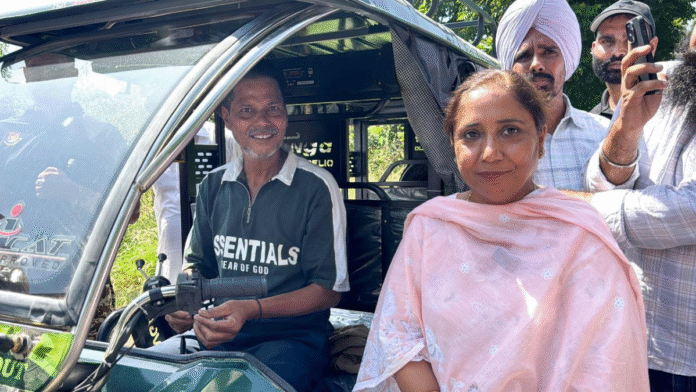
Punjab Water Resources Minister Barinder Kumar Goyal visited the affected areas in Sultanpur Lodhi along with Member of Parliament Balbir Singh Seechewal and Deputy Commissioner Amit Kumar Panchal. During his visit to Sangra village, the minister traveled by boat to inspect flood damage. Local farmers confronted him with complaints about the lack of flood preparation and delayed compensation from the previous year.

In response, the minister said that the Chief Minister is personally monitoring the relief work and assured complete compensation for damage and crop loss. He added that orders for special surveys have already been issued in the affected tehsils of Sultanpur and Bholath.

According to the minister, the protective embankments are currently safe and stable and the situation is being tracked continuously by government officials.

In Ferozepur, nearly sixty four villages have been affected by the flooding. Over eighty six hundred acres of farmland are under water in twenty five villages. Among the worst affected are Alewala, Ashike, Nihala Lavera, Tanabagga, Bandala, Kaleke Hithar, and several others.

Gurmej Singh, a former village head from Nihala Lavera, described the dire conditions. He said homes are damaged, people have lost work, and families are struggling to find food and fodder for their cattle.

District Commissioner Deepshikha Sharma visited the flood-hit areas and directed officials to supply green fodder and veterinary medicines. She also urged villagers to report weak spots in embankments and said medical camps and relief supplies have already reached some of the affected communities.

At Hussainiwala, floodwaters entered Pakistan and then bounced back into Indian territory after hitting embankments on the other side. This led to flooding of fields and fencing areas near Gatti Rajoke which is located about fourteen kilometers from Ferozepur. A Border Security Force outpost near Satpal was also impacted. BSF teams have increased both boat and foot patrols in the area.

Local farmer Balbir Singh said that each time the river rises, water hits Pakistan’s embankments and is pushed back into Indian villages. He warned that if the water level increases again, the defence drain could overflow just like it did last year.

Authorities have issued a fresh warning that any rise in the Sutlej could cause more flooding in the villages located near the international border.

To prevent further loss of learning in flood-affected areas, government schools in Ferozepur have started online classes from Thursday. Residents from villages like Nihala Lavera, Dheera Ghara, and Alewala had been requesting this move, worried that nearly four hundred students might fall behind due to blocked access to schools.

DC Deepshikha Sharma confirmed that online learning would begin immediately and senior students would be shifted to nearby schools if needed. She instructed the education officer to implement the plan without delay to ensure board exam students can continue their studies.

Japan’s Takeda Turns to India to Push Quicker Drug Rollouts

0

Japanese pharmaceutical major Takeda is considering India as a base for global clinical trials in an effort to bring new medicines to market more quickly, the company’s India head told Reuters.

The discussions come at a time when India’s clinical trials industry is expanding rapidly, supported by a diverse patient population, cost advantages, and an expanding hospital network. Research firm Grand View projects the sector to surpass 2 billion dollars by 2030.

“India is a critical growth market for us, and we are committed to long-term investments here, both in innovation and in building new capabilities,” said Annapurna Das, general manager of Takeda India. She declined to disclose the scale of investment but confirmed that the company is assessing how best to use India’s trial ecosystem.

Takeda is also open to working with universities, healthcare providers, and technology partners in India as it refines its approach, Das said, while noting that specific plans are still under evaluation.

Ultimately, the company aims to weave India’s research and development environment into its global operations, giving patients in the country broader access to advanced treatments in cancer, neuroscience, gastrointestinal disorders, and inflammation. Takeda expects to introduce several oncology drugs in India over the next few years, starting with a lung cancer treatment scheduled for release this year. The company also has a dengue vaccine in the pipeline, developed with local manufacturer Biological E., which is awaiting regulatory approval.

Earlier this year, Takeda opened an innovation centre in Bengaluru to draw on India’s technology expertise for its global digital transformation. The facility already employs more than 500 specialists in artificial intelligence, data science, engineering, and design, and is set to expand to a workforce of 750.

Rahul Gandhi’s Allegations on Missing Voters Challenged by Bihar Authorities

0
Rahul Gandhi
Rahul Gandhi

Election officials in Bihar on Tuesday rejected the accusations made by Congress MP Rahul Gandhi, who posted videos on X featuring Subodh Kumar from Nawada and Ranju Devi from Rohtas. Both individuals claimed that their names had been removed from the voter list during the special intensive revision of electoral rolls in the state.

Gandhi raised these cases during his ongoing Voter Adhikar Yatra, a state-wide campaign that began on August 17 to highlight alleged irregularities in the electoral process.

Nawada district magistrate Ravi Prakash responded to the allegations through a post on X, calling Kumar’s claim false and without merit. He clarified that Kumar’s name had never been included in the electoral rolls. In the video, Kumar, who identifies as a farmer, alleged that he was removed from the list despite having voted in the 2025 Lok Sabha elections and serving as a polling agent.

According to Prakash, Kumar’s name did not appear in any version of the Warisaliganj constituency roll, whether it was the 2024 summary revision, the 2025 supplementary roll, or the August 1 draft. While other members of his household were moved between polling stations 9 and 10, Kumar’s name was absent throughout. His name was also not listed in the deleted voters’ list that is publicly displayed in line with Supreme Court instructions.

Prakash further stated that Kumar had been present when the booth-level officer published the voter list but did not file an objection or submit Form 6, even after being advised to do so. He added that if Kumar now submits the required form and declaration, his name will be added according to the rules.

In Rohtas, electoral officials addressed similar claims made by Ranju Devi, who alleged that her family’s names were missing from the voter list. An inquiry conducted by the electoral registration officer of the 207 Chenari constituency found that eight members of her household were indeed listed at booths 342 and 343. Later, television footage showed Devi admitting that she had been misinformed by her ward secretary, who mistakenly told her their names had been removed during the revision process.

Faissal Khan Accuses Aamir Khan of Hiding Truth About Jessica Hines, Asserts He Has Evidence

0
Aamir Khan
Aamir Khan

The strained relationship between Aamir Khan and his brother Faissal Khan has surfaced again as Faissal revealed he has completely cut himself off from the family. He accused Aamir of having a relationship with UK-based journalist Jessica Hines during his marriage to Reena Dutta and claimed that a child was born from that affair. Faissal has now stated that Aamir would not be able to deny these allegations.

On Aamir getting offended by him
During a conversation with Hindustan Times, Faissal reflected on the time he wrote a harsh letter to his family after they pressured him to remarry. He recalled that Aamir was already divorced from Reena Dutta and living with Kiran Rao at that point.

“After my divorce, my family started putting pressure on me to get married to my auntie… I was telling them to let me work and settle down. I got so upset and angry that I wrote a letter which was slightly abusive in nature to point out the relationships of my family members,” Faissal said.

He added, “My sister Nikkhat had 3 marriages. Aamir went through a divorce with Reena. He had a child with Jessica Hines out of wedlock. And then was staying with Kiran Rao… I wanted to tell them to look at themselves first. They took offense to that letter and my opposition to get married and declared me mad… No one likes to know the truth about how their marriages, and their relationships are not working out. I put that mirror in front of their face.”

On Aamir’s divorce with Reena
Aamir and Reena were married in 1986 and have two children together, Ira and Junaid. The couple officially parted ways in 2002.

Looking back at that phase, Faissal said, “I was there around when his relationship was not working with Reena. They got divorced and then he went into his work. I was also struggling with my work.”

“Around the time of his divorce, Aamir had started his production company, Aamir Khan Productions, with the film Lagaan. He was involved with his work a lot, and Reena was also helping him in the front. I could see his relationship going bad and with everything was happening with Reena, but I couldn’t help it. That was his decision. He had to live his life,” he added.

Faissal further explained that witnessing Aamir’s separation from Reena contributed to his own emotional turmoil. “I was like why are you telling me to get married again,” he said.

On Aamir’s affair with Jessica
Faissal reiterated that Aamir was romantically involved with Jessica Hines while still being married to Reena and later began living with Kiran. “I was seeing the atmosphere and saying let me also take my decision since everyone is taking their right decisions. Allow me also to live my life freely,” Faissal stated.

Faissal goes on to claim, “Everyone knows that he has had a relationship with Jessica and he has a child. He can’t deny that. You can do a DNA test. I have proof of everything that I am saying… It’s not me who’s just fabricating.” According to Faissal, Aamir has gone to great lengths to shape a public identity that is far from genuine.

“He is trying to create a clean image for the audience, but you can find out his image by him having so many relationships with women and all that… He likes to whitewash his image which is not the reality,” he says while wrapping up.

Online Gaming Regulation Bill Brought to Lok Sabha as SIR Debate Rages

0
Parliment
Parliment

A new bill aimed at regulating and banning specific forms of online gaming was brought to the Lok Sabha on Wednesday as opposition protests continued over the voter list revision exercise in Bihar.

Union Minister Ashwini Vaishnaw introduced the legislation while opposition members shouted slogans and held up placards in protest.

Congress MP Manish Tewari was invited to voice his objection to the bill at the introduction stage but declined, stating that the House should first address the ongoing issue regarding Bihar’s Special Intensive Revision process.

RSP leader N K Premachandran also opted not to speak, maintaining that the House was not in a proper state to proceed with discussion.

Parliamentary Affairs Minister Kiren Rijiju criticized the opposition, remarking that the level of disruption had become so severe that even schoolchildren were mocking the behavior of lawmakers.

As the commotion persisted, P C Mohan who was chairing the session decided to adjourn proceedings until two in the afternoon.

The bill proposes to ban real-money online gaming and related advertisements while introducing penalties including fines or imprisonment for violators. It clearly distinguishes between gambling-based platforms and eSports or casual online games.

The proposed legislation also encourages the development and promotion of eSports and social gaming platforms.

New Round of India-China Discussions to Define Official Boundary Lines

0
India and China
India China relations

India and China have made notable progress in their long-standing border discussions, with both sides agreeing to begin the process of delimiting the less-disputed stretches of the boundary. This development came during the 24th round of Special Representative talks held in New Delhi between National Security Advisor Ajit Doval and visiting Chinese Foreign Minister Wang Yi.

Although specific details remain under wraps, both sides have reportedly identified areas within the three major sectors of the border where tensions are minimal. These locations will serve as starting points for a phased approach to the overall resolution. The first step involves forming a technical expert group under the Working Mechanism for Consultation and Coordination on India-China Border Affairs, led by a Joint Secretary from India’s Ministry of External Affairs. The next phase will involve selecting tracts of land with minimal friction, followed by the actual delimitation process. The final stage will see physical demarcation on the ground with boundary markers.

This step-by-step strategy signals a shift toward a more pragmatic and incremental method for building trust, allowing both sides to demonstrate progress on manageable sections of the border before tackling more complex disputes.

On the security front, the two nations have also discussed measures for de-escalation in Eastern Ladakh, following the tense standoff that began in May 2020. While the matter of buffer zones in contested areas remains unresolved, there is a mutual understanding to move toward a non-threatening military posture. This includes withdrawing tanks, artillery, and other heavy weapons to safer distances, reducing the risk of sudden escalation.

Given the terrain advantages on the Chinese side of the Line of Actual Control—primarily the flat Tibetan plateau—the Indian military’s position in the mountainous Ladakh region demands careful and strategic adjustment to ensure balance without provoking hostilities.

With both sides expressing a commitment to maintain long-term peace along the border, efforts are underway to bring bilateral ties back to the pre-2020 level. Despite India’s concerns over China’s growing involvement in Pakistan and broader regional influence, the push toward normalization gained momentum after the October 2024 meeting between Prime Minister Narendra Modi and President Xi Jinping.

Their upcoming meeting on August 31 at the Shanghai Cooperation Organization summit in Tianjin is expected to further this progress, potentially opening the door to more stable and mutually beneficial engagement between the two countries.