Home Blog Page 91

Clear Your Traffic Fines: Delhi’s Lok Adalat is Here This Week

0
Delhi
Delhi

Delhi: Delhi Traffic Police has announced a National Lok Adalat scheduled for September 13, providing motorists with a one-day opportunity to settle outstanding traffic violations. The initiative allows vehicle owners to download their pending challans starting Monday, September 8, and resolve their cases without prolonged court proceedings.

Seven Venues Across Delhi

Coordinated with the Delhi State Legal Services Authority (DSLSA), the Lok Adalat will operate simultaneously across seven court complexes: Patiala House, Karkardooma, Tis Hazari, Saket, Rohini, Dwarka, and Rouse Avenue. Sessions will run from 10 am to 4 pm, accommodating maximum participation.

Eligibility and Process

The program targets motorists with pending compoundable traffic challans or notices. Participants must download and print their challans in advance through the Delhi Traffic Police website or by scanning the department’s QR code. The download facility became operational on September 8 at 10 am.

However, access remains limited with strict quotas in place. Only 60,000 challans can be downloaded daily, with an overall ceiling of 1.8 lakh challans. Traffic authorities have urged motorists to download their documents immediately to avoid missing the opportunity once quotas are exhausted.

Understanding Delhi’s Lok Adalat System

A Lok Adalat, meaning “People’s Court,” represents an alternative dispute resolution mechanism established under the Legal Services Authorities Act, 1987. These forums handle compoundable cases including traffic violations, utility disputes, cheque bounce cases, and certain family matters outside traditional court systems.

The proceedings maintain an informal atmosphere, presided over by panels comprising judges, lawyers, or social workers. Crucially, when settlements are reached, Lok Adalat decisions carry the same legal weight as civil court decrees while charging no court fees.

Strategic Timing

This initiative comes as Delhi grapples with mounting traffic violations and court backlogs. The streamlined settlement process offers mutual benefits—motorists avoid lengthy legal procedures while authorities clear pending cases efficiently.

The success of this National Lok Adalat could set precedent for similar initiatives across Indian metropolitan areas, potentially revolutionizing how traffic violations are resolved nationwide.

Now, Get Your Dream Car Audi In This Price: Here’s How GST 2.0 Helped!

0
Audi
Audi

German luxury automaker Audi India has announced significant price reductions across its entire product lineup following the implementation of GST 2.0, offering customers savings ranging from Rs 2.6 lakh to Rs 7.8 lakh depending on the model. The strategic price cuts aim to boost sales momentum during the upcoming festive season, making premium vehicles more accessible to Indian buyers.

Audi India price cut amid GST 2.0 implementation

The most substantial reduction applies to the flagship Q8 SUV, which sees a dramatic price drop of Rs 7.83 lakh. Previously retailing at Rs 1.17.49 crore, the Q8 now starts at Rs 1.09.66 crore (ex-showroom). This aggressive pricing strategy positions the luxury SUV more competitively in India’s growing premium segment.

The popular Q7 SUV benefits from a Rs 6.15 lakh reduction, bringing its starting price down from Rs 92.29 lakh to Rs 86.14 lakh (ex-showroom). Similarly, the mid-size Q5 SUV receives a price cut of up to Rs 4.55 lakh, now starting at Rs 63.75 lakh compared to its earlier Rs 68.30 lakh price tag.

The compact Q3 SUV, Audi’s entry-level offering, drops from Rs 46.14 lakh to Rs 43.07 lakh (ex-showroom), providing a more attractive entry point into the Audi ecosystem.

In the sedan segment, the executive A6 sees a reduction of Rs 3.64 lakh, now priced from Rs 63.74 lakh (ex-showroom). The A4, targeting younger professionals, becomes Rs 2.64 lakh more affordable at Rs 46.25 lakh (ex-showroom).

Will GST 2.0 implementation help the customers?

These price adjustments come as India’s luxury car market shows robust growth, with increasing demand for premium German brands. The GST 2.0 framework appears to have created favourable conditions for automakers to pass on benefits to consumers.

Potential buyers can visit authorized Audi India dealerships nationwide or check the official website for model-specific pricing details. The timing of these reductions, just ahead of the festive buying season, could significantly boost Audi’s market share in India’s competitive luxury automobile segment.

The move reflects Audi’s commitment to expanding its Indian footprint while making German engineering more accessible to aspirational buyers.

Centre okays ₹675 crore CRIF package for 10 road works in Bihar; eight districts to get widening, strengthening and a key border link

0

What’s been approved

The Ministry of Road Transport & Highways has cleared ₹675 crore for 10 state road projects in eight Bihar districts under the CRIF window. State road construction minister Nitin Nabin announced that the schemes include widening/strengthening works and a high-level bridge, aimed at shortening travel times and improving safety on busy corridors.

Where the money will go (highlights)

  • Araria: a 30-km road from Jaynagar (Bhargama) to Ghurna (Narpatganj) up to the India–Nepal border (₹135 cr).
  • Buxar (SH-17): Chausa–Gola–Kochas section including a bridge (₹117.49 cr).
  • Saran: 12 km strengthening in Taraiya (₹48.68 cr).
  • Nawada: 11.6 km link via multiple villages (₹45 cr).
  • Madhubani: 12.5 km Ramnagar–Motipur Khaira strengthening (₹72 cr).
  • Bhagalpur: 17.14 km Bhagalpur–Kotwali via Gora Dih (₹80 cr) and 4.5 km connector from SH-19 to NH-80 (₹56.7 cr).
  • East Champaran: 11 km Dhaka–Laukhan widening (₹42.5 cr) and 15.55 km Nargir–Champapur–Adapur strengthening in Motihari (₹47.42 cr).
  • Purnia: 11.2 km Ghamdaha–Kuari strengthening (₹29.48 cr).

Why CRIF matters (and how it’s funded)

CRIF is the Centre’s dedicated pool for state roads and related infrastructure, created by statute and funded via a cess on petrol and diesel that’s credited to the Consolidated Fund of India and then allocated per rules/guidelines. In short: it’s a predictable channel that states can tap for well-scoped road works.

Bigger picture: part of a growing pipeline

This clearance lands days after Bihar’s minister met Union minister Nitin Gadkari seeking ₹1,100 crore under CRIF for 15 schemes/226 km, and amid parliamentary updates that place Bihar’s current highway package at 3,092 km / ₹70,726 crore under various central programmes. The ₹675-crore tranche shows the ask-to-approval funnel is moving.

What it means on the ground

  • Border trade & security: The Araria border road tightens a critical spur to the Nepal frontier, easing movement of goods and emergency services.
  • Decongestion & safety: Widening + strengthening on SH-17 (Buxar) and links in Bhagalpur/Motihari should reduce crash risks and cut travel time on over-stressed stretches.
  • District balance: With East Champaran, Bhagalpur, Madhubani all featuring, the package is geographically spread, complementing earlier cabinet-cleared upgrades and expressway announcements.

Punjab floods update: 22,854 evacuated; toll rises to 46 as 48 more villages go under

0

At a glance (as of Sept 6, evening)

Punjab’s flood toll climbed to 46, with three additional fatalities reported in the past 24 hours. Fresh inundation hit 48 villages, taking the cumulative impact to 1,996 villages across 22 districts and affecting 3,87,013 people. Authorities report 22,854 people evacuated so far.

Where the water spread in the last 24 hours

New flooding was concentrated in Jalandhar (19 villages) and Ludhiana (13), with further impacts in Ferozepur (6), Amritsar (5), Hoshiarpur (4) and Fazilka (1). These additions show the deluge continuing to edge into pockets beyond the original river belts.

Evacuations & shelters

Another 925 residents were moved to safety in the past day, bringing total evacuations to 22,854. 139 relief camps are currently operational and housing 6,121 people; in all, 219 camps have been opened at various points in the response. Districts with the largest evacuation totals include Gurdaspur (5,581), Fazilka (4,202), Ferozepur (3,888) and Amritsar (3,260).

Human toll

Three fresh fatalities were confirmed in Amritsar and Rupnagar, pushing the statewide toll to 46 across 14 districts. Officials also reported three missing persons in Pathankot. Separate national coverage mirrored the numbers and emphasized the severity of this year’s floods.

Damage to farms

Cumulative crop loss has crossed 1.74 lakh hectares across 18 districts. The heaviest-hit farmland lies in Gurdaspur (40,169 ha), Kapurthala (17,574 ha), Ferozepur (17,257 ha), Fazilka (18,649 ha), Tarn Taran (12,828 ha), Hoshiarpur (8,322 ha), Sangrur (6,560 ha) and SAS Nagar (2,000 ha).

Forces & assets in the field

The state says 23 NDRF teams are operating across ten districts, alongside 2 SDRF teams in Kapurthala. The Army has deployed 27 columns and 7 Engineer Task Forces; nine helicopters from the Air Force and Army are airborne for rescue and drops. The BSF is assisting in the Ferozepur sector. In total, 158 boats plus one state helicopter are part of the response.

Outlook for the next 48 hours

A regional broadcast update signalled no heavy rain forecast in the immediate two-day window and noted a slight easing in water levels—welcome news for relief, though officials caution that assessments can begin only as waters pull back further.

What’s next

District administrations plan comprehensive damage surveys after recession to firm up compensation for households and farmers, even as evacuation and medical teams continue to operate in pockets where access remains cut off.

Bihar’s ‘Divyang Marriage Incentive’ pivots from ceremony support to seed capital for livelihoods

0

What’s new

Bihar has highlighted a state-run incentive that gives up to ₹1,00,000 to newly married couples where at least one partner is a person with disability (PwD). The Social Welfare Department says beneficiaries may deploy the money not only for wedding-related expenses but also to kickstart self-employment or meet essential household needs—an explicit push to make couples economically self-sustaining. The latest update, carried by IANS, underlines the scheme’s intent and the real-life use cases reported by recipients.

What the scheme offers

Under the Mukhyamantri Divyangjan Vivah Protsahan Anudan Yojana, eligible applicants receive a lump-sum grant up to ₹1 lakh. Official scheme listings reiterate the amount and the purpose—social security and encouragement of marriage for PwDs—with flexibility to use funds for livelihoods and essentials.

Who can apply (at a glance)

  • Disability threshold: At least one spouse must be a resident of Bihar and have ≥40% disability (the “benchmark disability” standard in Indian policy).
  • Marriage & age: Applications must be made within one year of marriage; minimum age 18 (bride) and 21 (groom)
  • Basic conditions: Applicants should belong to poor families and be domiciled in Bihar. (Legacy scheme forms and notices carry the ₹1 lakh figure and similar conditions.

Tip: In practice, couples use a UDID card or disability certificate to establish benchmark disability. The Union government confirms the UDID platform is the standard rails for disability certification and scheme access.

How it links to livelihoods

Bihar has stacked multiple measures around disability inclusion this year. Most notably, the Cabinet approved the Mukhya Mantri Divyangjan Udyami Yojana, which offers ₹5 lakh interest-free loan + ₹5 lakh subsidy to help PwDs start micro-enterprises. This sits naturally alongside the marriage incentive, turning a one-time grant into a stepping stone to entrepreneurship for eligible couples who want to expand.

A wider safety net: pensions & identity coverage

Beyond start-up support, Bihar has raised the monthly social-security pension to ₹1,100, which includes the disability category, with the first tranche disbursed to over 1.11 crore beneficiaries statewide. That predictable monthly income can stabilize cash flow for newly married PwD households experimenting with self-employment.

On identity and access, the latest Lok Sabha reply shows Bihar had issued 6,44,259 UDID cards by 13 August 2025, with 1,18,916 applications pending; 152 hospitals in the state are integrated with the UDID system—evidence that the admin rails for disability benefits are steadily widening.

Why this matters

Census-linked profiles show Bihar has a higher share of children in its disabled population and historically low workforce participation among PwDs—constraints that a cash grant plus enterprise support can ease by funding tools, inventory or shop improvements. The state’s focus on last-mile documentation (UDID), pension adequacy, and credit-plus-subsidy lowers the classic barriers that stall micro-businesses in their first year.

How beneficiaries say they’re using it

Recent field reports collected by the press describe couples upgrading or reopening small shops and planning to diversify inventory using the incentive money—an early sign that households are treating the grant as seed capital rather than a one-off windfall.

What to watch next

  • Operational circulars & timelines: District Social Welfare Offices typically publish application windows and document checklists; the scheme requires filing within one year of marriage.
  • Convergence with Udyami loans: Tracking how many grant recipients step up to the ₹10 lakh Udyami package (loan + subsidy) will reveal whether the ladder from incentive to enterprise is working.
  • Inclusion via UDID: With issuance and hospital integration rising, watch for camp drives and faster certification so eligible couples don’t miss the one-year window.

Bihar to start work on 704 rural bridges from Sept 10 under CM Gramin Setu Yojana

0

Bihar will begin construction of 704 small bridges on 10 September 2025 under the Mukhyamantri Gramin Setu Yojana (MGSY). The plan carries an outlay of ₹3,688 crore, is aimed squarely at rural “missing links” and flood-weakened crossings, and comes with unusually tough execution terms: start work by Sept 10 or face forfeiture of security deposits and blacklisting. A district-wise schedule places East Champaran (56) at the top, followed by Darbhanga (38); several others—including Gaya, Siwan, Sitamarhi (30 each)—also see heavy coverage.

The bridge blitz is designed to lock in gains from a larger rural-infrastructure rollout unveiled earlier this monsoon. On July 17, 2025, the state launched ₹21,406 crore of works: 11,346 rural roads and 730 bridges across schemes of the Rural Works Department. That package mixed projects already starting with those moving to foundation-stone stage—an approach that builds a steady pipeline into FY 2025-26 and beyond. The 704-bridge tranche now fills the stubborn, short gaps that often sever access in the rains.

Policy continuity matters here. Bihar revived the CM Rural Bridge scheme in September 2024 after a gap, explicitly to tackle flood damage and missing links on rural roads. Think of the 704 as year-two scaling of that revival, with stricter timelines and district targeting.

Enforcement has teeth. Apart from written warnings of blacklisting in recent notices, the Rural Works Department maintains a public debarment/blacklist registry, a nudge for on-time starts and site presence during the monsoon construction window.

Why this focus on small bridges? Evidence on India’s rural-road programmes shows that all-weather connectivity does more than cut travel time: it shifts labour into non-farm work, helps keep children in school longer, and raises the odds of institutional births—especially when roads are paired with reliable crossings that stay open in the rains. World Bank impact evaluations of PMGSY (a national analogue) document shorter journeys and a shift toward non-farm employment; other studies link rural roads to higher school attainment and 11–13 percentage-point gains in institutional deliveries. Those are exactly the outcomes Bihar is chasing by funding not just roads, but the short bridges and approach roads that unlock them year-round.

There’s also an eye on resilience and upkeep. After a spate of bridge failures nationally, Bihar approved a Bridge Management & Maintenance Policy (2025) that brings AI/ML into inspection and prioritises preventive maintenance—critical in riverine districts like East Champaran, Darbhanga, Bhagalpur and the Kosi belt where scouring and approach-road washouts are common. Building 704 bridges is one half; keeping them serviceable through flood cycles is the other.

What to watch next:

Tender packages and mobilization—contracts that hit the Sept 10 start line versus those slipping into the post-monsoon backlog;
Approach roads—the plan explicitly funds approaches so bridges don’t become stranded assets; and
District sequencing—with East Champaran, Darbhanga and Gaya high on the list, expect early activity where vulnerability and demand were flagged through Janata ke Darbar townhalls. The state’s messaging—and the published district breakdown—suggest a participatory selection and a focus on habitations long cut off by seasonal waters.

Nitish Flags Off Landmark Punpun Suspension Bridge Alongside Multiple Projects in Patna

0

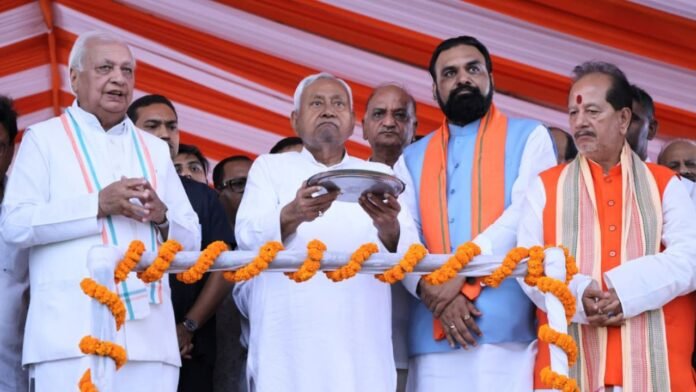
Nitish Kumar on Friday announced a series of development initiatives in Patna district amounting to nearly ₹1,159.84 crore. One of the key highlights of the programme was the inauguration of Bihar’s first cable suspension bridge, built across the Punpun river and designed on the lines of the Laxman Jhula in Rishikesh. The project, completed at a cost of ₹82.99 crore, was formally opened by the Chief Minister.

A statement from the Chief Minister’s Office said that a total of 17 projects were inaugurated or had their foundation stones laid during the event. These included the construction of a bridge and approach road linking Samda and Gularia Vigha villages in Paliganj at ₹19.77 crore, the creation of tourism facilities at the Ular Sun Temple in Paliganj for ₹14.99 crore, and the building of a connecting road from Punpun station through Akona village to the Patna Ring Road at a cost of ₹88 lakh.

Among the other works were a two-lane road to connect Sohagi Mor on the Sadikpur Pabheda Masaurhi route with Kandaap on the Patna Gaya road, as well as the suspension bridge at the Punpun Pinddaan site valued at ₹82 crore.

The package also carried a major focus on strengthening the energy sector. Capacity enhancement of power transformers in eight substations has been approved at a cost of ₹10.20 crore, while reconductoring of 20 new 33 kV lines will require ₹26.02 crore. Construction of 21 additional 33 kV lines is to be taken up with ₹70.31 crore, and transformer upgrades in 18 substations will involve ₹22.99 crore, the release added.

Bihar CM Nitish Kumar Launches Women-Centric Schemes Ahead Assembly Polls

0
BIhar
Bihar

Bihar Chief Minister Nitish Kumar has unveiled a series of welfare schemes targeting women voters in the months leading up to the state assembly elections, following a strategy that has proven successful for the BJP and NDA in other states.

Here’s recent policy changes in Bihar:

The government initiated its campaign three months ago with significant policy changes. On June 24, the Cabinet approved increasing monthly pensions for elderly, widows, and disabled persons from ₹400 to ₹1,100. The first installment worth ₹1,227 crore was disbursed on July 11 to 1.11 crore beneficiaries across six schemes, with approximately 54.5% being women.

In July, Bihar imposed domicile requirements for the existing 35% women’s reservation in government jobs, restricting benefits to Bihar residents only. On July 30, the CM also increased ASHA workers’ monthly honorarium from ₹1,000 to ₹3,000 and doubled Mamata workers’ incentives from ₹300 to ₹600 per delivery.

Bihar Govt. to provide employment to women

The centerpiece announcement came on August 29 with the Mukhya Mantri Mahila Rozgar Yojana, allocating ₹20,000 crore for women’s self-employment. Under this scheme, one woman per family receives an initial ₹10,000 grant to start a business. After six months of successful operation, beneficiaries can access additional funding up to ₹2 lakh for expansion.

The government plans to develop local “haat bazaars” where women entrepreneurs can sell products. Officials announced the first tranche distribution for September.

Banking Support

Prime Minister Narendra Modi released ₹105 crore on September 2 as initial capital for Bihar Rajya Jeevika Nidhi Credit Co-operative Federation Limited, a dedicated bank for women’s self-help groups. This initiative aims to provide rural women linked to Bihar’s Jeevika Self Help Groups easier access to affordable credit.

Electoral Significance in Bihar

Women voters have shown higher turnout rates in recent elections. In 2020 assembly polls, 59.69% of registered women voted compared to 54.68% of men. The 2024 Lok Sabha elections showed similar patterns with 65.78% female turnout versus 65.80% male turnout.

CM Nitish Kumar has consistently courted women voters since 2005, implementing 50% reservation in local bodies (2006), free bicycles for schoolgirls, and graduation-linked financial assistance under various schemes.

CM Nitish Kumar Inaugurates Bihar’s 1st Cable Suspension Bridge

0
Nitish Kumar
Nitish Kumar

Bihar Chief Minister Nitish Kumar inaugurated the state’s first cable suspension bridge over the Punpun River, marking a significant infrastructure milestone that promises to transform regional connectivity and religious tourism.

The 320-meter modern cable suspension bridge, constructed adjacent to Bihar’s Patna in Punpun, draws architectural inspiration from Rishikesh’s famous Lakshman Jhula. The project aims to facilitate easier access for devotees visiting the Punpun Pinddan site while boosting local commerce and daily transportation.

About Technical Specifications of Bridge in Bihar

The engineering marvel features impressive technical specifications designed for light vehicle traffic:

  • Total length: 320 meters
  • Suspension deck: 120 meters
  • Support system: 18 robust steel cables
  • Pylon height: 100 feet
  • Approach road: 135 meters
  • Duct length: 200 meters

Project Timeline and Investment

Construction commenced on August 31, 2019, with an initial budget allocation of ₹46.77 crore. However, the final project cost escalated to approximately ₹83 crore over the construction period. Officials report that 99 percent of the work has been completed, enabling the bridge’s immediate public opening following the inauguration ceremony.

Strategic Benefits

The suspension bridge addresses multiple regional development objectives. Religious pilgrims and tourists traveling to Punpun’s sacred Pinddan site will experience significantly reduced travel times and improved accessibility. Local residents will benefit from enhanced connectivity for business activities and daily commuting, while reduced traffic congestion is expected along existing routes.

The infrastructure development aligns with Bihar’s broader tourism promotion strategy, potentially attracting visitors familiar with similar structures in Uttarakhand.

Chief Minister Nitish Kumar’s Vision

During the inauguration ceremony, Chief Minister Nitish Kumar emphasized the project’s broader significance for Bihar’s development trajectory.

“Bihar’s development journey reaches a new milestone with this bridge. This represents not just engineering excellence, but also symbolizes public convenience and progress,” CM Nitish Kumar stated.

The cable suspension bridge represents Bihar’s first venture into this specific infrastructure category, demonstrating the state’s commitment to adopting modern engineering solutions for regional connectivity challenges. The project combines traditional religious significance with contemporary transportation needs, reflecting the integration of faith-based tourism with practical infrastructure development.

PM Modi Responds to Trump’s “Always Be Friends” Remark Amid Trade Tensions, Says…

0
PM Modi`
PM Modi

Prime Minister Narendra Modi on Saturday reciprocated US President Donald Trump’s sentiment about maintaining friendship despite current bilateral tensions over trade tariffs and India’s Russian oil imports.

PM Modi reacts on Trump’s “Friends” remarks

“Deeply appreciate and fully reciprocate President Trump’s sentiments and positive assessment of our ties. India and the US have a very positive and forward-looking Comprehensive and Global Strategic Partnership,” PM Modi posted on X (formerly Twitter).

The response came after Donald Trump’s Friday remarks characterizing India-US relations as a “very special relationship” while expressing reservations about India’s current policies.

Donald Trump’s Mixed Messages amid tension

“I’ll always be friends with PM Modi. He’s a great Prime Minister. I’ll always be friends, but I just don’t like what he is doing at this particular moment. But India and the United States have a very special relationship. There is nothing to worry about. We just have moments on occasion,” Trump stated, specifically referencing India’s Russian oil purchases.

The US President indicated that trade discussions with India are “going well” despite existing tensions.

Escalating Trade Disputes

Relations between the two nations have deteriorated following the Trump administration’s imposition of secondary tariffs on India for purchasing Russian oil. US tariffs on Indian exports now exceed 50 percent, representing the highest tariff rate Trump has implemented alongside Brazil.

India condemned these measures as “unfair, unjustified, and unreasonable,” highlighting the strain in bilateral economic relations.

PM Modi’s Strategic Realignments in China

During the Shanghai Cooperation Organisation (SCO) Summit in China’s Tianjin, PM Modi was photographed engaging warmly with Chinese President Xi Jinping and Russian President Vladimir Putin. The images showed the three leaders shaking hands, embracing, and smiling, demonstrating unity amid their respective tensions with the United States.

“Lost India to China” Controversy

Trump previously claimed the US had “lost India to China” but later clarified his position.

“I don’t think we have (lost India). I’ve been very disappointed that India would be buying so much oil from Russia. I let them know that. We put a very big tariff on India- 50 percent, a very high tariff. I get along very well with PM Modi, as you know. He was here a couple of months ago, in fact, we went to the Rose Garden and had a press conference,” Trump explained to media.

The diplomatic exchange reflects ongoing efforts to maintain personal relationships despite policy disagreements.