Home Blog Page 43

Sam Altman Clarifies OpenAI Doesn’t Want a Government Bailout as AI Bubble Fears Rise

0
OpenAI
OpenAI

Sam Altman has rejected the suggestion that OpenAI is seeking federal financial protection for its massive AI infrastructure investments, responding a day after one of the company’s top executives hinted that the US government might play a role in supporting its financing plans. Writing on X on Thursday, Altman said OpenAI does not have and does not want government guarantees for its data centers, adding that taxpayers should not be expected to rescue companies that make poor financial decisions or fail in the market.

Altman explained that the only conversations involving government support have been about possible loan guarantees related to semiconductor manufacturing in the United States. He said this was in response to the US government’s push for domestic chip production under the CHIPs Act, which offers tens of billions of dollars in grants, loans, guarantees and tax credits. He also stated that OpenAI never filed a formal application.

The clarification comes as OpenAI moves forward with plans to spend roughly $1.4 trillion on chips and data centers in the coming years, a scale that has prompted renewed warnings about a potential AI investment bubble, especially given that the company has not yet turned a profit.

In an interview a day earlier, OpenAI’s chief financial officer Sarah Friar said the company was exploring support from banks and private equity firms, and she suggested that the government could help make financing possible by backing it in some form. The comment drew attention from several industry observers, including White House adviser David Sacks, who publicly insisted that Washington will not rescue AI companies if they run into trouble.

After questions began circulating, OpenAI issued a clarification saying Friar had been speaking about the broader industry, not about any specific request from OpenAI. Friar later echoed that clarification herself, writing that she was not referring to a government guarantee for OpenAI’s own infrastructure and that her phrasing had created confusion.

Altman added that it might be reasonable for governments to build their own AI infrastructure to serve public needs, but he emphasized that OpenAI expects to fund its own expansion through rapid revenue growth. He said the company expects to reach an annual revenue run rate of twenty billion dollars by the end of this year and is aiming to scale that figure into the hundreds of billions by 2030. According to Altman, the long-term spending plan of 1.4 trillion dollars will only be possible if revenue continues to grow, and every step of that growth will require significant effort, though the company remains confident in its trajectory.

Trump Intensifies Charge on Russian Oil, Claims ‘India Has Mostly Stopped’ Amid Tariff Tensions

0
trump modi

Just days after suggesting that India was preparing to halt its imports of Russian crude, US President Donald Trump has doubled down on the claim, this time asserting that New Delhi has already “significantly scaled back” its purchases.

Speaking to reporters at the White House on Friday, Trump said discussions with India were progressing well, and hinted at a possible visit to the country next year. “Talks with India are going well. He’s mostly stopped buying oil from Russia,” Trump said, referring to Prime Minister Narendra Modi. “He’s a friend of mine, we stay in touch, and he wants me to visit. We’ll see how to work that out — I will go.”

The comment marks the strongest public assertion yet from Trump suggesting that India is moving away from discounted Russian crude — something New Delhi has not confirmed.

Trump repeated his assertion on Friday during a media interaction at the White House, where he also hinted that he might visit India next year. He said that trade discussions between the two countries were progressing well and claimed that India had largely stopped buying Russian oil. He described Prime Minister Narendra Modi as a friend and said they were in touch, adding that Modi wanted him to visit India and that he would consider the trip.

Trump’s renewed comments on India’s Russian oil imports come while trade negotiations between Washington and New Delhi are still underway. Russian crude remains a key point of contention in those talks. Earlier this year Trump imposed a fifty percent tariff on Indian goods which went into effect in August. Although his tone toward India has softened since then, he continues to insist that India must end its oil trade with Russia. Half of the tariff was justified on the grounds that India continued to buy energy from Moscow, and the move was seen as part of a wider attempt to pressure Vladimir Putin to halt the war in Ukraine.

India became Russia’s largest crude buyer after the United States first introduced sanctions over the invasion of Ukraine. Between January and September 2025, India reportedly imported about 1.7 million barrels per day, making up roughly one third of its total oil intake.

Trump previously claimed that Prime Minister Modi had personally assured him that India would stop purchasing Russian oil. He first made the statement in October and repeated versions of the claim several times afterward. However, India publicly denied that such a conversation had taken place. The Ministry of External Affairs stated that it was not aware of any phone call between the two leaders, and spokesperson Randhir Jaiswal made it clear that no such discussion had occurred.

Trump’s latest remarks represent a shift from his earlier claim. He now says that India has largely stopped buying Russian oil, instead of saying the move was still being finalized.

His comments also came shortly after the United States imposed sanctions on two major Russian oil companies, Rosneft and Lukoil, in an effort to force Moscow to end the conflict in Ukraine. In response to the sanctions, India said it was evaluating the situation and would base future decisions on market conditions and national interests.

If you want this shortened, more formal, or made into a news-style paragraph, just let me know.

ATC Glitch Causes Chaos at Delhi Airport, Over 150 Flights Affected

0
Delhi Airport

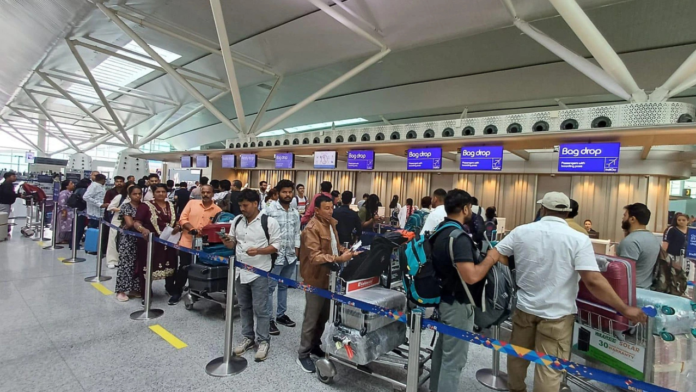
More than 150 flights leaving Delhi’s Indira Gandhi International Airport were delayed on Friday morning after a major technical glitch hit the air traffic control system.

The problem was traced to a failure in the Automatic Message Switching System, the software that sends essential flight plan information to the tracking system used by air traffic controllers.

According to the Airports Authority of India, the fault forced controllers to switch to manual processing of flight plans, which slowed down operations and led to long queues of aircraft waiting for clearance. The authority said technical teams were already working to restore the system and requested passengers to cooperate during the disruption.

Delhi Airport normally manages over 1,500 flight movements a day, making it the country’s busiest aviation hub. Data from Flightradar24 showed that more than 500 flights had already faced delays on Thursday, and another 171 were delayed by Friday morning. Many morning departures were running almost an hour behind schedule, with delays rising as the day progressed.

Officials familiar with the issue said the malfunction began around 3 pm on Thursday, and since then controllers have been forced to create and verify flight plans manually—something that significantly slows down departures. One official described the situation inside the ATC as “chaotic,” noting that such a failure had not been seen before.

Airlines began issuing alerts to passengers. IndiGo informed flyers that flights to and from Delhi, as well as some other northern airports, were being affected, and asked customers to expect longer wait times. Air India also posted an update, calling the disruption “unforeseen” and advising passengers to check their flight status before heading to the airport.

The delays are expected to continue until the system is fully restored.

No Respite Ahead as Delhi AQI Falls to ‘Very Poor’ Category

0
Delhi
Delhi AQI

Delhi’s air quality dipped back into the “very poor” category on Thursday as the Air Quality Index climbed to 311, a sharp rise from the morning reading of 278. A day earlier, the capital recorded an AQI of 202, which fell under the “poor” category.

Forecasts from central agencies indicate that the situation is unlikely to improve anytime soon, with Delhi expected to remain in the “very poor” zone for at least the next six days. Fine particulate matter, especially PM2.5, continues to be the primary pollutant driving the deteriorating air quality.

Neighbouring cities also reported troubling figures. Data from the Central Pollution Control Board showed that Noida, Greater Noida, Gurugram and Faridabad were all in the “poor” bracket on Thursday.

According to the weather department, wind speeds are likely to pick up slightly during the afternoon, reaching around 15 kmph from the northwest, before slowing down again to below 10 kmph by evening and night on November 6.

In Haryana, Faridabad recorded a 24-hour average AQI of 218, while Manesar stood at 269, both categorised as “poor.” Noida and Greater Noida logged readings of 257 and 228, and Ghaziabad reported 266, all within the same range.

Under CPCB guidelines, an AQI between 0 and 50 is considered “good,” 51 to 100 is “satisfactory,” and 101 to 200 is classified as “moderate.” A score between 201 and 300 is labelled “poor” and may cause breathing discomfort with prolonged exposure. The “very poor” range of 301 to 400 can trigger respiratory illness, while 401 to 500 is marked as “severe,” posing health risks even to otherwise healthy individuals.

Once Worth ₹2 Lakh Crore to Google, This Startup Is Now on Sale For an Absurd Price

0
Google
Google

Google’s massive 32 billion dollar (about ₹2.8 lakh crore) purchase of cybersecurity firm Wiz has taken a major step forward, with the US Department of Justice reportedly giving the deal a green light after completing its antitrust review. This approval brings the acquisition much closer to the finish line.

From turning down an offer to sealing a record deal

When Google first offered to buy Wiz in 2024 for 23 billion dollars (around ₹2 lakh crore), CEO and co-founder Assaf Rappaport refused, insisting the company was capable of scaling far beyond that valuation. A year later, that decision proved right. Google returned with a revised offer, this time for 32 billion dollars, making it one of the largest cybersecurity acquisitions in history. The deal was made public in March 2025 and is now expected to close by early 2026, according to Reuters.

Why Wiz matters to Google

Wiz, founded in Israel and now based in New York, has quickly become a leader in cloud security. Its platform scans huge cloud setups for weaknesses across services like AWS, Microsoft Azure and Google Cloud, and is already used by major corporations including Morgan Stanley and DocuSign. The company has more than 1,000 employees spread across the US, Europe, Israel and Asia.

For Google, the acquisition is a strategic push to strengthen Google Cloud, a business unit still trailing behind Amazon and Microsoft. The move also comes shortly after Google backed away from a potential HubSpot takeover, signalling a shift toward cybersecurity as a priority area.

What happens next

With regulatory approval secured, the deal now enters its final phase before completion. Once finalised, Wiz will operate under Google Cloud and Rappaport along with the existing leadership team is expected to remain in place.

Wiz’s journey, from rejecting a ₹2 lakh crore offer to being sold for nearly ₹2.8 lakh crore, highlights both its explosive growth and the rising importance of cloud security in today’s digital economy.

Karnataka HC Stands Firm, Refuses To Vacate Stay On Public Gathering Curbs

0
Karnataka HC

The Karnataka High Court on Thursday refused to lift the interim stay on the state government’s October 18 order that restricted unauthorised gatherings of more than ten people in public places including roads, parks, and playgrounds.

The directive was issued in the middle of a dispute between the Congress-led state government and the Rashtriya Swayamsevak Sangh regarding permissions for its annual route marches. The government order stated that any such gatherings would be considered an “unlawful assembly” and would attract punishment under the Bharatiya Nyaya Sanhita.

On October 28, a single-judge bench of the Karnataka High Court led by Justice M Nagaprasanna stayed the government’s order, noting that the state could not restrict peaceful assembly without legislative backing and that administrative convenience alone could not justify such curbs.

The state government later challenged the decision, but on Thursday, a division bench of Justices SG Pandit and Geetha KB of the Dharwad Bench declined to interfere with the stay.

Advocate General Shashi Kiran Shetty argued that the government had not imposed a blanket ban but merely required organisers to obtain prior permission. He told the court that the directive was an “enabling provision” and a “positive measure” aimed at maintaining public order and protecting government property.

“All the government order states is that encroaching on government property would constitute an offence under the Bharatiya Nyaya Sanhita,” Shetty said during the last hearing on November 4. “We are not preventing peaceful gatherings, but processions and rallies involving large crowds cannot be held in public parks or on roads without prior approval.”

Shetty added that citizens remained free to hold cultural or civic events by seeking permission or using private venues such as community halls.

Senior advocate Ashok Harnahalli, representing the Hubballi-based NGO Punashchetana Seva Samsthe that challenged the order, argued that the constitutional right to peaceful assembly under Article 19(1)(b) can be restricted only on grounds of public order and not through executive action.

Harnahalli described the order as “manifestly arbitrary,” saying that if enforced, it would absurdly require even people wanting to “play cricket in a public playground to seek daily permission from the authorities.”

Probe Ordered by Fadnavis Into Pune Land Deal Connected to Deputy CM Ajit Pawar’s Son

0
Fadnavis

Maharashtra chief minister Devendra Fadnavis on Thursday ordered an inquiry into allegations of irregularities in a Pune land deal linked to Parth Pawar, the son of deputy chief minister Ajit Pawar.

“I have asked for all the details and ordered a probe. The truth in this matter will be brought out,” Fadnavis said, as the state government suspended a sub-registrar and set up a three-member committee to investigate the case.

According to the allegations, the sub-registrar’s office waived stamp duty worth ₹21 crore on the registration of a 40-acre land sale in Mundhwa valued at ₹300 crore. The land was sold to Amedea Enterprises LLP, a firm in which Parth Pawar is a partner. The property lies close to Pune’s upscale Koregaon Park area.

Revenue minister Chandrashekhar Bawankule said the committee would determine whether the exemption in stamp duty complied with the law. “There are specific legal provisions concerning Mahar Watan land and exemptions in stamp duty for particular purposes,” he said.

Bawankule added that he had instructed the probe committee to verify whether the legal provisions governing Mahar Watan land were followed. Mahar Watan refers to hereditary land grants made to members of the Mahar community.

Ravindra Binwade, inspector general of registration and controller of stamps, said the three-member panel would submit its report within ten days. “The committee will examine the circumstances under which the stamp duty was waived and review all documents submitted,” Binwade stated, adding that the joint inspector general of registration would head the panel.

Repeated attempts to contact Parth Pawar for comment were unsuccessful. Documents reviewed by HT show that the address of Amedea Enterprises matches Parth Pawar’s residence in Pune’s Yawant Nagar. The registration papers list Amedea Enterprises as the buyer, with Digvijay Amarsinh Patil, the other partner in the firm, signing the documents.

Defence Minister Rajnath Singh Tells Rahul Gandhi Not to Politicise the Army

0
Rajnath Singh
Rajnath Singh

Defence Minister Rajnath Singh on Wednesday strongly criticised Congress leader Rahul Gandhi for his comments during an election rally where he called for reservation in the armed forces. Singh warned Gandhi not to involve the military in political matters.

“Do not bring the Army into politics. Soldiers have only one religion, and that is ‘Sainya Dharma’. Whenever the nation has faced a crisis, our soldiers have made the country proud with their courage and sacrifice,” Singh said while addressing a rally in Bihar.

During his speeches in Banka and Jamui, Singh also accused the Leader of the Opposition in the Lok Sabha of trying to spread disorder in the country by demanding reservation in the armed forces.

At a campaign rally in Kutumba, Bihar, on Tuesday, Rahul Gandhi had claimed that the Indian Army was “under the control of 10 percent of the country’s population,” referring to the dominance of upper castes in the institution.

Responding to this, the Defence Minister said that while the BJP supports reservation for the poor, the Army must remain above such divisions. “There should be reservation, and we support it. But when it comes to the Army, our soldiers have only one religion, and that is ‘Sainya Dharma’. There is no other religion beyond that. Do not bring politics into the Army. Whenever India has faced a challenge, our soldiers have upheld the country’s honour through their bravery,” he said.

Singh added that politics based on caste, community, and religion has caused great damage to the country. “Our goal is to uplift every section of society without discrimination. The people and sages of our nation have never believed in dividing society by caste or religion,” he said.

Referring to Operation Sindoor, Singh mentioned that all major terrorist hideouts were destroyed during the mission and noted that the operation has only been paused, not ended.

In his earlier speech, Gandhi spoke about economic inequality, claiming that despite 90 percent of India’s population belonging to marginalised communities such as Dalits, backward classes, and minorities, they remain underrepresented in corporate India, bureaucracy, the judiciary, and other key institutions.

“They control the banks, most jobs, and even the judiciary. They dominate the Army too, while 90 percent of the population is excluded from these spaces,” Gandhi said.

Chirag Paswan, Union Minister and leader of the BJP’s ally LJP (RV), condemned Gandhi’s remarks, calling them “shameful and unfortunate.” He stated that the Army should never be seen through the lens of caste or religion and that such statements insult the soldiers who serve the entire nation.

“The Army should not be politicised. His words are an insult to our soldiers. It is both shameful and unfortunate. If the Leader of the Opposition views our Army in terms of caste and religion, nothing could be more regrettable,” Paswan told reporters in Patna.

Senior BJP leader Shahnawaz Hussain also criticised Gandhi, accusing him of “speaking the language of urban naxals.”

“Rahul Gandhi is echoing the language of urban naxals. He has not even spared the Army. He should apologise to the nation. His words have hurt the morale of our soldiers, and the people of India will not forgive him for this,” Hussain said.

Maruti Suzuki Sets Record as First Indian Carmaker to Reach 3 Crore Sales

0
Maruti Suzuki
Maruti Suzuki

Maruti Suzuki India Ltd. has become the first Indian automaker to cross cumulative sales of three crore vehicles, marking a major milestone that reflects the dominance of the country’s largest car manufacturer over its 42-year history.

The New Delhi-based company reached its first crore sales in 28 years and 2 months, the second crore in 7 years and 5 months, and the third crore in just 6 years and 4 months, according to data released by the company in its monthly updates. These figures also include sales made to other manufacturers such as Toyota India.

Top-selling Maruti Suzuki models among the three crore cars
Maruti Suzuki Alto: over 47 lakh units
Maruti Suzuki Wagon R: over 34 lakh units
Maruti Suzuki Swift: over 32 lakh units

The company’s latest top performers, the Brezza and Fronx, also rank among the ten best-selling models, highlighting the growing popularity of SUVs even within India’s biggest small-car brand.

While the three crore milestone is a remarkable achievement, Maruti Suzuki CEO Hisashi Takeuchi emphasized that the company’s journey is far from complete. “With car penetration at about 33 vehicles per 1,000 people, we know our journey is far from over,” he said in a statement on Wednesday, November 5, 2025. “We will continue striving to bring the joy of mobility to as many people as possible while contributing to both the economy and the environment.”

On Tuesday, Maruti Suzuki shares declined 1.76% to ₹15,370.45 each on the BSE, while the benchmark Sensex closed 0.62% lower at 83,459.15 points. The stock market remains closed today in observance of Guru Nanak Jayanti.

Next-Gen Samsung TVs to Feature HDR10+ Advanced With 5000-Nit Displays and AI Tone Mapping

0
Samsung
Samsung

Samsung has unveiled HDR10+ Advanced, an upgraded version of its HDR10+ format designed for its premium 2026 television lineup. Coming shortly after Dolby’s introduction of Dolby Vision 2, the launch marks the next stage of competition in high dynamic range (HDR) technology for televisions and streaming platforms.

HDR10+ Advanced: Key Upgrades
The latest version introduces several improvements aimed at enhancing brightness, color accuracy, and tone mapping. The standout feature, HDR10+ Bright, uses extended metadata and AI-driven image processing to deliver higher brightness, richer color volume, and more precise contrast. It is optimized for displays capable of achieving peak brightness levels between 4,000 and 5,000 nits and supports the full BT.2020 color spectrum, which will be available on Samsung’s upcoming Mini-LED and Micro RGB televisions.

Another addition, HDR10+ Genre, employs AI-based content recognition and creator-provided metadata to automatically fine-tune tone mapping based on the type of content being viewed. Whether it’s sports, films, or animation, the system adapts visual settings to ensure each genre is displayed at its best.

The update also adds Intelligent Motion Smoothing, allowing creators to define the degree of frame interpolation for individual scenes. Televisions will then adjust playback dynamically based on lighting conditions and viewer preferences.

Improved Tone Mapping and Color Control
HDR10+ Advanced refines local tone mapping through more precise zone-based adjustments, enhancing shadow and highlight detail while reducing blooming. It also introduces Advanced Color Control, which refines color metadata to produce smoother and more natural color transitions.

For gamers, the format brings HDR10+ Intelligent Gaming, a feature that uses real-time tone mapping to adjust screen brightness according to ambient lighting. It is compatible with both console and cloud-based HDR gaming environments.

HDR10+ Advanced: Launch Timeline
Although Samsung has not yet showcased its new 115-inch Micro RGB television in person, the company presented a simulated comparison highlighting visible improvements in contrast and color richness. A full technical demonstration is planned for CES 2026.

The first televisions supporting HDR10+ Advanced are expected to reach consumers around mid-2026. Amazon Prime Video has already confirmed compatibility, while other major platforms such as Netflix and Disney+ are expected to add support once the new metadata structure is incorporated into their HDR systems.

Samsung’s 2025 television lineup launched in May, suggesting that the first HDR10+ Advanced models may arrive around the same period next year. The success of the rollout will depend on how quickly content creators and streaming services adopt the updated metadata framework necessary to unlock the format’s full potential.