

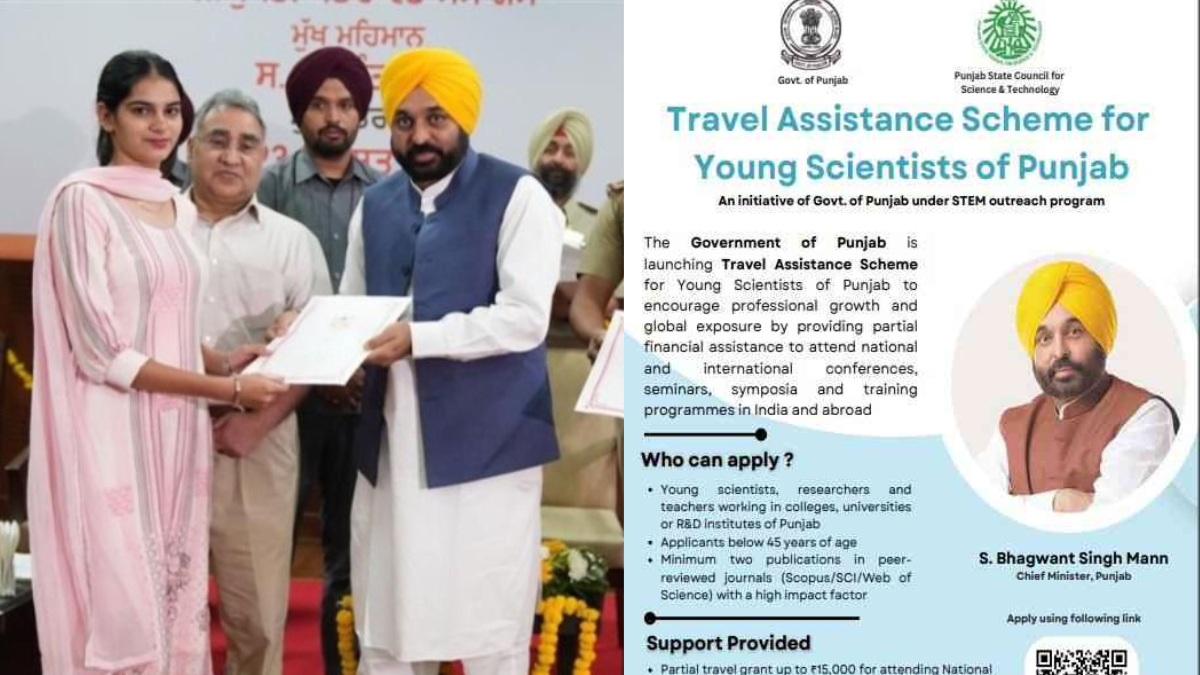
Punjab’s scientific community has received a major boost as the state government, under Chief Minister Bhagwant Singh Mann, introduced a transformative initiative aimed at empowering young researchers. The newly launched “Young Scientists Travel Assistance Scheme” is being hailed as a landmark move that places Punjab’s emerging scientific talent on the global map.
Instead of allowing financial barriers to hinder progress, the government has chosen to actively support the next generation of innovators. This program, operated through the Punjab State Council for Science and Technology (PSCST) as part of the STEM Outreach Program, focuses on a problem long faced in academic circles: many gifted researchers lack the resources to attend leading global conferences and present their work among international peers.
The scheme prioritizes scientists, technologists, and educators below the age of 45 working in Punjab’s universities, colleges, and research institutes. Only applicants with at least two research publications in recognized peer-reviewed journals such as Scopus, SCI, or Web of Science are eligible. By setting these criteria, the government ensures that support reaches those actively contributing to scientific advancement.
Through this initiative, selected applicants will receive up to ₹15,000 as travel assistance, covering half of their airfare or maintenance allowance, along with the registration fees required to participate in major national and international conferences, workshops, short-term training programs, seminars, and other academic gatherings. This exposure is expected to open doors for collaborations, provide access to modern research trends, and align Punjab’s scientific research with global standards and the state’s own developmental priorities.
Chief Minister Bhagwant Singh Mann has emphasized that this scheme symbolizes Punjab’s belief in the capabilities of its youth. He noted that scientific progress flourishes when young minds are encouraged to explore and participate in discussions that shape the future of technology and research worldwide. According to him, this assistance is not merely financial; it is an investment in the dreams and ambitions of young scholars who aspire to contribute meaningfully to society.
The initiative also reflects a broader shift in the governance of Punjab. Development is no longer restricted to constructing buildings or launching infrastructure projects. Instead, the focus has expanded to strengthening human capital and safeguarding the aspirations of younger generations. Unlike the past, when many well-intentioned schemes never moved beyond paperwork, visible change is now taking place in the state.
By introducing this program, the Punjab government has sent a clear message: talented youth will receive the support they need to grow. The scheme promises to nurture innovation, promote academic excellence, and enable Punjab’s researchers to compete globally with confidence. Citizens across the state are increasingly recognizing that promises are being translated into action, and that opportunities for progress are being created in real time.
Those interested in applying or learning more about the initiative can visit the official website of the Punjab State Council for Science and Technology at www.pscst.punjab.gov.in


