

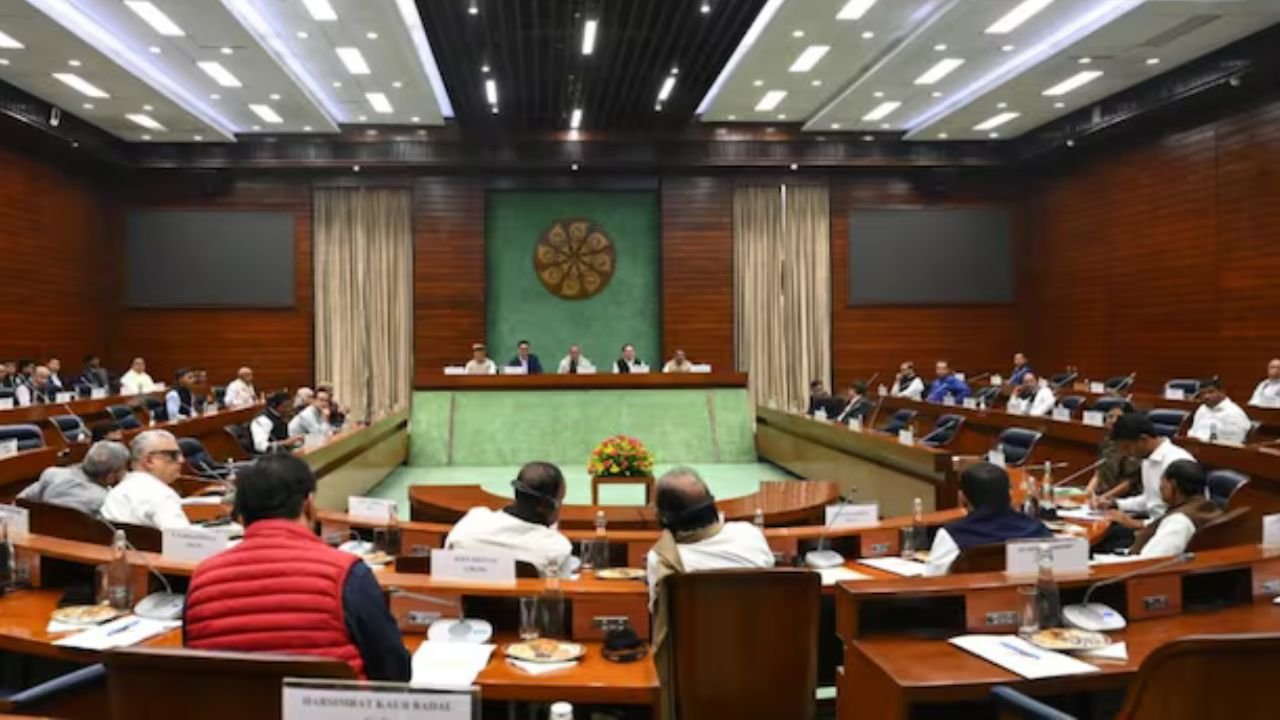
Winter Session: The central government convened an all-party meeting Sunday ahead of Parliament’s Winter Session, which begins Monday and runs through December 19 for 15 sittings—one of the shortest winter sessions in recent years compared to the usual 20 sittings.
Parliamentary Affairs Minister Kiren Rijiju urged constructive debate, stating: “Since it’s the winter season, we hope everyone works with a cool head and avoids heated exchanges. Debate is part of Parliament and I hope there will be no disturbances. Working with a calm mindset will benefit the nation and ensure the session runs smoothly.”
Opposition’s Concerns
Congress MP Gaurav Gogoi accused the government of deliberately curtailing parliamentary proceedings. “The winter session is only 19 days long, of which discussions can take place only for 15 days. This will likely be the shortest winter session ever. Therefore, it seems the government itself wants to derail Parliament,” he stated.
The opposition flagged multiple issues for discussion including electoral roll revisions, the recent Delhi blast, air pollution, economic security, and foreign policy matters. “The blast in Delhi is, in some ways, a testimony to the failures of our legal and home affairs departments,” Gogoi said, adding that security of voter lists and election integrity should be discussed.
Legislative Agenda in Winter Session
The government plans to introduce 14 bills, headlined by the Atomic Energy Bill, 2025, which seeks to regulate atomic energy use while enabling private sector participation in nuclear operations.
The Higher Education Commission of India Bill, 2025, aims to establish a central commission promoting university autonomy, transparent accreditation mechanisms, and stronger regulatory oversight for academic standards.
Other significant legislation includes the Jan Vishwas (Amendment of Provisions) Bill, 2025; Insolvency and Bankruptcy Code (Amendment) Bill, 2025; Securities Markets Code Bill, 2025, consolidating three existing acts into unified market code; Insurance Laws (Amendment) Bill, 2025; and Arbitration and Conciliation (Amendment) Bill, 2025, proposing revisions following recent Supreme Court observations.
Additional bills cover corporate laws, national highways, central excise, and a Health Security & National Security Cess.
The government recently withdrew plans to empower the President to directly issue Chandigarh regulations after cross-party objections, demonstrating the political significance of coordination forums.


