

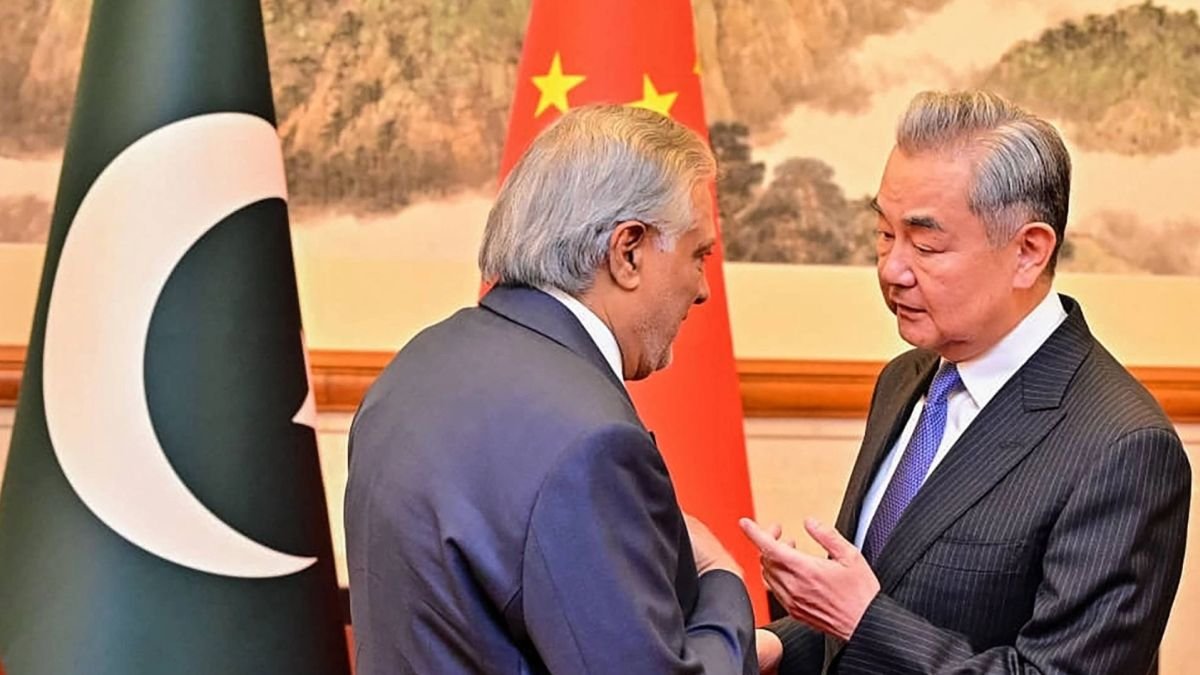
India’s Ministry of External Affairs on Tuesday strongly rejected references to Jammu and Kashmir in the recent joint statement issued by China and Pakistan, reiterating that Jammu and Kashmir along with Ladakh are inseparable parts of India.
MEA spokesperson Randhir Jaiswal said India’s stand on the matter has remained unchanged and is well known to all parties involved.
“The Union Territories of Jammu & Kashmir and Ladakh have been, are and will always remain integral and inalienable parts of India,” Jaiswal stated.
He further asserted that no foreign country has the authority to comment on matters related to India’s sovereignty and territorial integrity.
India rejects references to CPEC
Responding to mentions of the China-Pakistan Economic Corridor in the joint statement, the MEA reiterated India’s opposition to projects passing through territory that New Delhi considers illegally occupied by Pakistan.
Jaiswal said India “resolutely opposes and rejects” any attempts by other nations to legitimise Pakistan’s control over these areas, adding that India has repeatedly conveyed its concerns to both Chinese and Pakistani authorities.
The statement also addressed references to “trans boundary water resources cooperation” between China and Pakistan.
According to the MEA, such terminology has no basis because the two countries do not directly share a boundary in the concerned region.
India also reiterated that it has never recognised the 1963 boundary agreement signed between China and Pakistan, under which Islamabad ceded territory in the Shaksgam Valley to Beijing.
Why the references matter
The references to Jammu and Kashmir and water cooperation in the China Pakistan statement are being viewed as Beijing signalling support to Islamabad on issues sensitive to India.
Observers believe the mention of water cooperation also reflects China’s attempt to strengthen strategic coordination with Pakistan amid broader regional tensions.
At the same time, Pakistan once again reaffirmed its support for the “One China Policy”, under which Taiwan is recognised as part of China. Beijing routinely seeks such reaffirmations from visiting foreign leaders during high level diplomatic engagements.
The statement also underlined China’s continued backing for Pakistan despite India’s objections over projects linked to CPEC.
Strategically, Beijing is also believed to be interested in expanding its presence around Gwadar, a key port located near the Persian Gulf and viewed as significant for China’s maritime ambitions in the region.
What the China Pakistan statement said
The joint statement was released following Pakistani Prime Minister Shehbaz Sharif’s official visit to China from May 23 to 26.
During the visit, Sharif held separate meetings with Chinese President Xi Jinping and Premier Li Qiang.
Both countries said they had reached broad consensus on further strengthening the China Pakistan All Weather Strategic Cooperative Partnership.
The statement noted that Pakistan briefed China on recent developments in Jammu and Kashmir, while Beijing said the issue should be resolved in line with the UN Charter.
The two sides also expressed willingness to pursue cooperation on “trans boundary water resources”, though no specific details were shared.


