

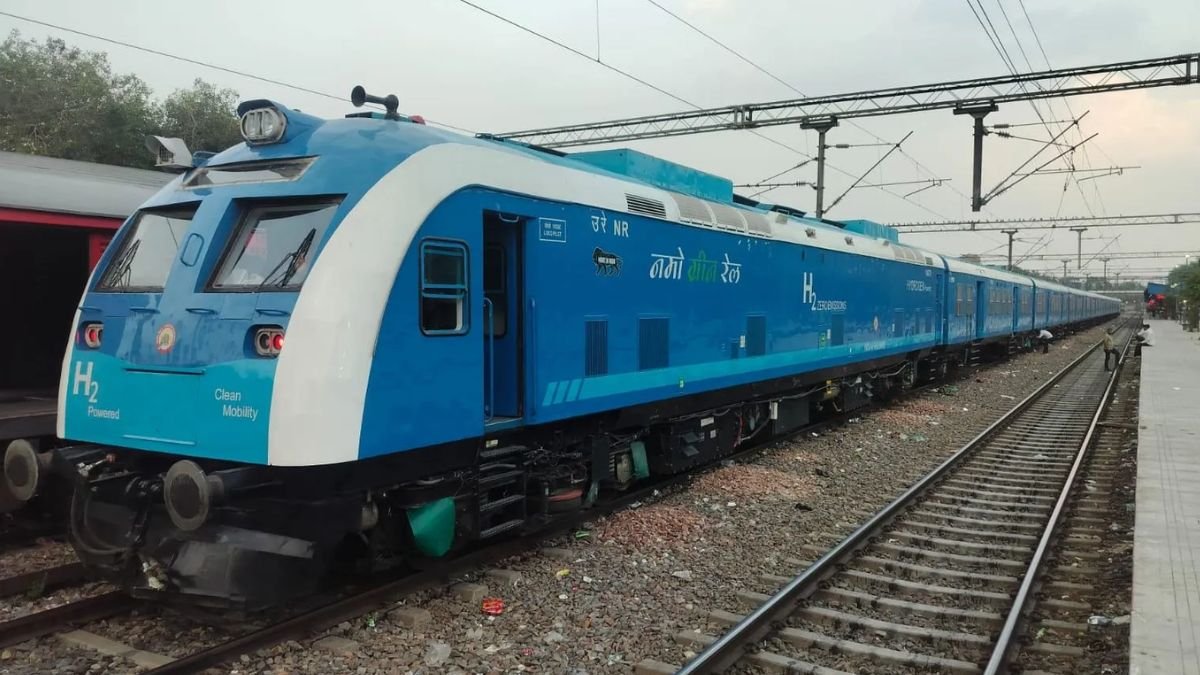
India’s first hydrogen-powered train underwent another round of trials between New Delhi and Jind on Friday, as engineers evaluated key performance parameters, including emergency braking distance and oscillation, ahead of its commercial rollout.
During the latest test run on the Jind-Sonipat section, the train reached a top speed of 120 kmph. However, its operational speed has been fixed at 75 kmph. Earlier trial runs had already been successfully conducted on the Sonipat-Jind route.
The Railway Board approved the introduction of the 10-coach hydrogen-powered train in a letter dated May 22. The Ministry of Railways officially announced the clearance on May 27, although a launch date for passenger operations has not yet been announced.
How the project works
The train is a modified diesel electric multiple unit (DEMU), a type of train commonly used on short and medium-distance routes across India. Instead of running on diesel, it has been retrofitted to operate using hydrogen fuel cell technology.
The conversion work was carried out by Hyderabad-based Medha Servo Drives in collaboration with Canada’s Ballard Power Systems, which supplied the hydrogen fuel cell technology.
The train comprises two 1,200 kW driving power cars and eight passenger coaches. With a combined power output of 2,400 kW, Indian Railways says it will become the world’s most powerful and longest hydrogen-powered train operating on a broad-gauge network.
Since Indian Railways plans to electrify most of its network, hydrogen-powered trains are primarily being developed for routes where electrification is difficult or for heritage railway lines. At present, around 35 routes have been identified under the Railways’ “Hydrogen for Heritage” initiative.
Hydrogen for the train will be supplied from a dedicated facility in Jind. The plant features a 1 MW polymer electrolyte membrane (PEM) electrolyser capable of producing around 420 to 430 kilograms of hydrogen every day.
The facility, built by GreenH Electrolysis, a joint venture between Spain’s H2B2 Electrolysis Technologies and the GR Promoter Group under a 2023 contract with Medha Servo Drives, also includes storage capacity for 3,000 kilograms of hydrogen along with two dispensing units to enable quicker refuelling.
On a full tank, the train is expected to cover nearly 250 kilometres.
The pilot project currently carries an estimated cost of ₹80 crore per train, while the supporting route infrastructure has been pegged at around ₹70 crore, excluding other associated development costs.
In a written reply in the Lok Sabha in December 2025, Railway Minister Ashwini Vaishnaw said it was too early to compare the costs of hydrogen-powered trains with conventional traction systems, as the project was still being implemented on a pilot basis.
Why the project is significant
The biggest advantage of hydrogen-powered trains is their environmental impact. Hydrogen fuel cells generate electricity through a chemical reaction between hydrogen and oxygen, producing only water vapour as the by-product and eliminating carbon emissions during operation.
With the project, India joins a select group of countries including Germany, Japan, China and the United States that have developed or are testing hydrogen-powered passenger trains. Germany’s Alstom Coradia iLint, which entered commercial service in 2018, was the world’s first hydrogen-powered passenger train.
For Indian Railways, hydrogen technology complements its broader goal of achieving net-zero carbon emissions. While electrification remains the primary strategy, hydrogen-powered trains are expected to serve routes where overhead electrification is either impractical or uneconomical, including difficult terrain and heritage railways such as the Nilgiri Mountain Railway, Darjeeling Himalayan Railway and the Kangra Valley Railway.
How hydrogen-powered trains work
Hydrogen fuel cells generate electricity through a process that is essentially the reverse of electrolysis. While electrolysis uses electricity to split water into hydrogen and oxygen, a fuel cell combines hydrogen stored onboard with oxygen from the air to produce electricity. The only by-products of this reaction are water vapour and heat, making the technology emission-free at the point of use.
The electricity generated by the fuel cells powers the train’s traction motors in much the same way as a conventional electric train. The key difference is that instead of drawing electricity from overhead power lines, a hydrogen-powered train produces its own electricity onboard.
The placement of hydrogen tanks and fuel cells differs depending on the train’s design. Germany’s Coradia iLint, for example, stores both the hydrogen tanks and fuel cells on the roof of two coaches. According to a 2024 peer-reviewed study published in ScienceDirect, the design takes advantage of hydrogen’s low density, allowing the gas to disperse quickly into the atmosphere in the event of a leak, thereby reducing explosion risks.
Switzerland’s Stadler FLIRT H2 follows a different approach by dedicating an entire coach exclusively to hydrogen storage and fuel cell systems, keeping the equipment completely separated from passenger compartments.
Battery systems also play a crucial role in almost every hydrogen-powered train, including India’s. They store surplus electricity produced by the fuel cells, along with energy recovered through regenerative braking. During periods of high power demand, such as acceleration, the batteries supplement the fuel cells to ensure a steady power supply.
Challenges facing hydrogen rail technology
Hydrogen-powered trains are not an experimental technology. Germany’s Alstom has operated hydrogen trains commercially since 2018, while Stadler’s FLIRT H2 set a Guinness World Record after traveling 2,803 kilometers over more than 46 hours without refueling.
However, several challenges continue to limit wider adoption.
One of the biggest hurdles is the production of green hydrogen. While hydrogen can be produced in different ways, only green hydrogen, generated by splitting water using renewable electricity, aligns with long-term decarbonization goals. Most of the hydrogen produced today is still grey hydrogen, which is derived from natural gas or other fossil fuels. Producing green hydrogen at scale remains expensive because of the high costs associated with electrolyzers and renewable energy.
Storage presents another major challenge. Hydrogen has a very low energy density by volume, requiring it to be compressed to pressures ranging between 350 and 700 bar before it can be stored efficiently onboard. The compression process itself consumes approximately 6 to 10 percent of the hydrogen’s energy content, according to the US Department of Energy.
Hydrogen’s molecular properties also create engineering challenges. Its extremely small molecules can gradually penetrate metals through a process known as hydrogen embrittlement, weakening storage tanks and other components over repeated use. Studies published in the International Journal of Hydrogen Energy and PubMed Central have identified this as a recognised concern for industries that store and transport compressed hydrogen.
Long-term exposure to hydrogen can also accelerate corrosion in metallic storage and refuelling infrastructure. As a result, manufacturers are increasingly adopting advanced composite materials instead of relying solely on metal pressure vessels.
Operational reliability is another area that remains under evaluation. India’s extreme weather conditions, ranging from intense summer heat to heavy monsoon rainfall, could place additional stress on hydrogen fuel cells in ways that have not yet been extensively tested in countries with more moderate climates, such as Germany.
Cost and scalability also remain significant barriers. Although hydrogen-powered rail technology has been commercially available for several years, its widespread deployment continues to lag behind conventional diesel, electric and battery-powered rail systems due to higher infrastructure costs and the challenges of producing and distributing hydrogen economically.


