

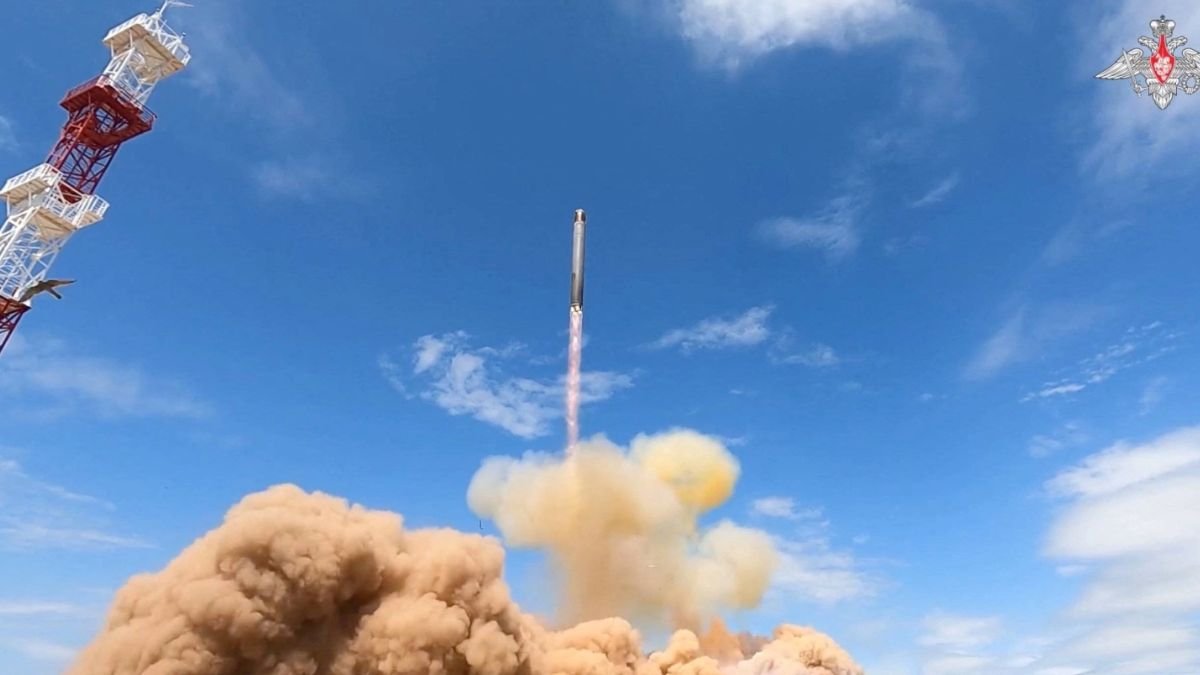
Vladimir Putin announced on Tuesday that Russia plans to deploy its nuclear capable RS-28 Sarmat intercontinental ballistic missile by the end of the year.
The announcement came during a televised meeting with senior military officials and marked Moscow’s latest effort to highlight its next generation strategic weapons programme amid continuing tensions with Western nations.
Describing the Sarmat missile as the world’s most powerful missile system, Putin claimed its warheads carry a combined destructive capability more than four times greater than comparable Western systems.
During the meeting, Sergey Karakayev informed Putin that the missile had successfully completed testing. He said the first regiment equipped with the system would be placed on combat duty in Russia’s Krasnoyarsk region before the end of the year.
Putin repeated that the Sarmat system possesses unmatched striking power compared to existing Western alternatives.
The announcement came shortly after the end of a three day ceasefire between Russia and Ukraine. The temporary truce, announced by Donald Trump, had allowed Russia to conduct its World War II Victory Day celebrations without disruption. Hostilities between Russia and Ukraine resumed on Tuesday following the ceasefire period.
Years of delays and setbacks
Despite Moscow’s latest declaration, the Sarmat missile programme has faced repeated delays over the past several years.
Russian state media had originally reported that the missile would enter service by the end of 2022. Although officials later claimed in 2023 that the system had already been placed on combat duty, Tuesday’s statements suggested the deployment process was still ongoing.
Russia first unveiled the Sarmat programme publicly in 2018 as part of a broader initiative to modernise its strategic weapons arsenal. The missile’s first test launch took place in April 2022, shortly after Russia launched its full scale invasion of Ukraine.
According to analyst Pavel Podvig, the latest successful launch represented only the second confirmed successful test since 2022, while the programme reportedly experienced at least two failed tests during that period.
Podvig described the missile largely as a political project, arguing that it would not significantly alter the balance of nuclear deterrence or military power.
Russia highlights wider strategic arsenal
During the meeting, Putin also pointed to several other advanced weapons systems developed by Russia in recent years. These included the Avangard hypersonic missile system, the Kinzhal air launched missile, the Oreshnik medium range missile system and the Poseidon underwater nuclear drone.
Putin additionally said that development work on the Burevestnik global range cruise missile was nearing completion. The missile is designed to operate using a miniature nuclear propulsion system.


