

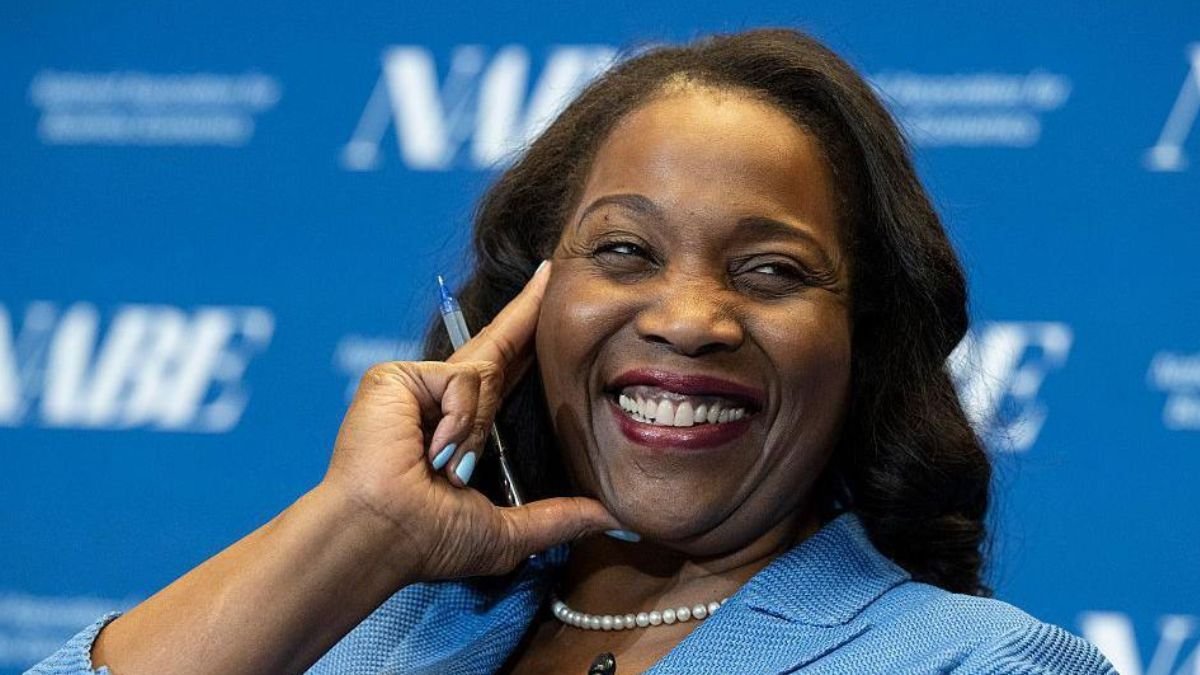
US President Donald Trump’s attempt to become the first American president to remove a sitting Federal Reserve official has suffered a major setback after the US Supreme Court blocked his move to dismiss Federal Reserve Governor Lisa Cook.
In a narrow 5-4 ruling on Monday, the nine-judge bench refused to allow Trump to remove Cook from office, according to Reuters. No US president has successfully fired a Federal Reserve official since Congress established the central bank in 1913.
The decision marks another legal setback for Trump during his second term, after the Supreme Court struck down most of his sweeping global tariff measures in a landmark ruling on February 20.
As one of the Federal Reserve’s seven governors, Cook plays a key role in setting US monetary policy alongside the heads of the country’s 12 regional Federal Reserve banks.
Despite the ruling, Trump signalled that he would continue pursuing action against Cook.
“We will take appropriate action immediately to make sure that someone who has committed wrongdoing will not be making vital decisions concerning the Welfare of the United States of America!” Trump wrote on social media, describing the court’s ruling as “strictly procedural.”
Why Trump wants Lisa Cook removed
Trump has repeatedly cited alleged mortgage fraud involving Cook as the reason for seeking her dismissal. The allegations, however, remain unproven.
Cook, who became the first Black woman to serve as a Federal Reserve governor after being appointed by former President Joe Biden in 2022, has rejected the accusations. She argued that Trump was using the allegations as a pretext to remove her because of disagreements over monetary policy.
When Congress established the Federal Reserve through the Federal Reserve Act in 1913, it sought to insulate the central bank from political influence by allowing presidents to remove governors only “for cause.” However, the law does not define what qualifies as “cause” or lay out a formal removal process.
Trump attempted to dismiss Cook on August 25, 2025, by posting a termination letter on social media. The letter cited allegations raised by Federal Housing Finance Agency Director Bill Pulte, a Trump appointee, concerning properties Cook owned in Ann Arbor, Michigan, and Atlanta.
In September, US District Judge Jia Cobb ruled that Trump’s attempt to remove Cook without prior notice or a hearing likely violated her constitutional right to due process. The judge also found that the allegations did not appear to meet the legal threshold required under the Federal Reserve Act because they related to events that occurred before Cook joined the central bank.
The US Court of Appeals for the District of Columbia Circuit later upheld that ruling.
The Supreme Court has now rejected the Justice Department’s request to lift the lower court’s order while Cook’s legal challenge continues.
Why the Federal Reserve matters
The Federal Reserve is regarded as the world’s most influential central bank, shaping interest rates and borrowing costs not only in the United States but across the global economy.
Cook’s term as governor is scheduled to run until 2038.
Trump’s efforts to remove Cook, coupled with a separate criminal investigation involving former Federal Reserve Chair Jerome Powell, have been viewed as one of the biggest challenges to the central bank’s independence in decades.
Powell completed his eight-year term as Fed chair on May 15 but remains a member of the Board of Governors. On May 13, the US Senate confirmed Trump’s nominee Kevin Warsh as the new Federal Reserve chair, and he officially assumed office on May 22.
Trump’s dispute with the Federal Reserve
Since returning to office, Trump has repeatedly criticised the Federal Reserve for refusing to cut interest rates more aggressively despite persistent inflation.
He frequently attacked Powell for resisting his demands, arguing that lower borrowing costs were necessary to support economic growth.
Legal experts say the Cook case could have major implications for the Federal Reserve’s ability to make monetary policy decisions independently of political pressure.
Another test of presidential power
The dispute over Cook’s removal is the latest legal battle stemming from Trump’s efforts to expand presidential authority during his second term.
Since returning to the White House in January 2025, Trump has used executive powers to reshape policies on immigration, military service, federal employment and several other areas.
While the Supreme Court has allowed many of those measures to proceed while litigation continues, it dealt Trump a major blow earlier this year by striking down most of his global tariffs.
That ruling invalidated tariffs imposed on nearly every US trading partner under a 1977 emergency powers law, marking another unprecedented move that no previous president had attempted.
Trump reacted angrily to the judgment, saying he was “absolutely ashamed” of some of the justices. He also criticised the court’s Republican-appointed judges, including two of his own nominees, calling them “fools” and “lapdogs” for Democrats.


