

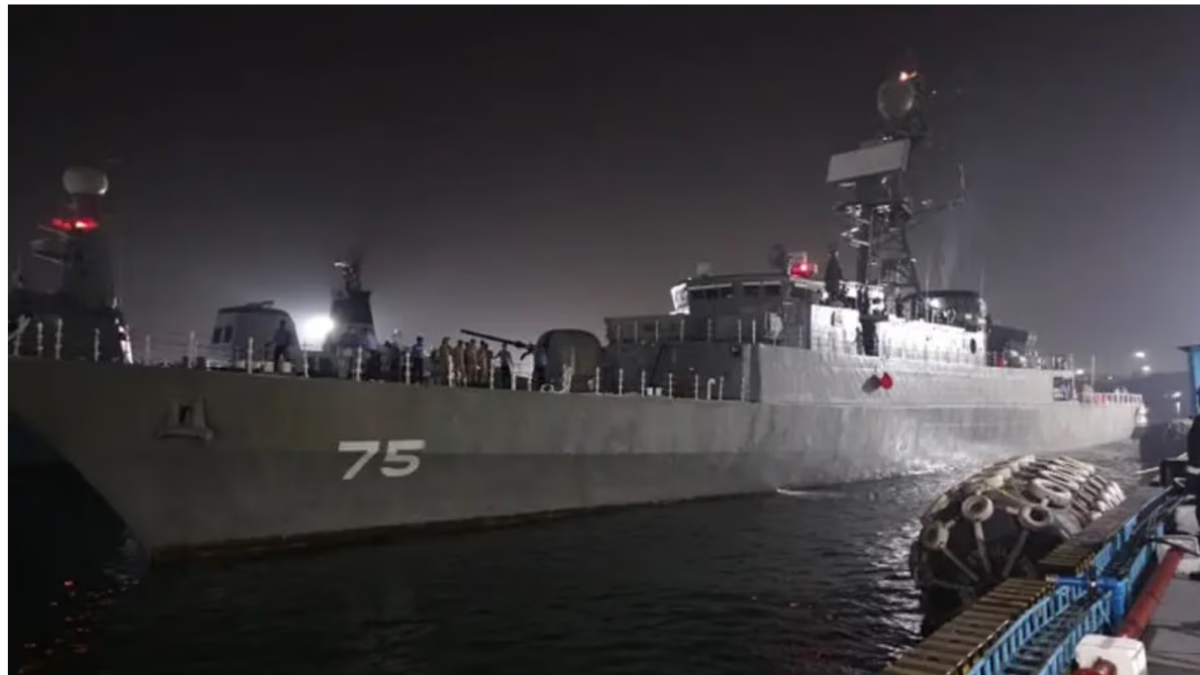
After a United States Virginia class nuclear attack submarine sank the Iranian corvette Dena on the high seas about 50 nautical miles off the coast of Galle, attention has now shifted to the Iranian military tanker Busheir, which is anchored roughly 10 nautical miles from the outer anchorage of Colombo Port. While Dena was destroyed by a torpedo with a range of about 20 nautical miles fired from a submarine in international waters, Busheir is currently positioned within Sri Lankan territorial waters.
As Iran attempted to target United States strike groups and oil tankers in the Strait of Hormuz, IRIS Dena and 17 other warships, including Russian built Kilo class submarines, were reportedly destroyed by the United States Navy in an effort to weaken Iran’s maritime threat to both warships and global shipping. For retired naval officers and commentators who argue that India should have protected IRIS Dena in international waters, the reality remains that India has no legal standing in the matter since it is not at war with either the United States or Iran. After Iran began targeting ships with kamikaze drones launched from warships and tankers, Dena effectively became a legitimate military target.
A retired admiral said that the situation has escalated into a full scale conflict between Iran and the United States, adding that the vessel would have been aware of the risks. He noted that while Iranian forces have targeted civilian infrastructure in Gulf countries, including airports, the loss of life in such incidents remains unfortunate.
Following the decimation of its top leadership on February 28, the weakened Iranian regime has attempted to widen the conflict by targeting Gulf nations such as Saudi Arabia and even Turkey for hosting United States military bases. In effect, Tehran and its allied groups are presenting Sunni countries with a stark choice of either facing attacks for supporting the United States or expelling American forces from their territory. Iran has tried to make an example of the United Arab Emirates because of its proximity and growing strategic influence in the region. However, these attacks have largely failed as the UAE and other Gulf states have managed to intercept many Iranian drones and missiles, whose numbers are reportedly declining as Tehran’s stockpile diminishes.
Although the United States and Israel have carried out extensive strikes on Iran using missiles and precision guided bombs, the prospect of regime change in Tehran remains uncertain. Populations often turn more nationalistic when attacked by foreign powers. In addition, the Islamic Revolutionary Guard Corps and its Quds Force continue to remain active, as seen in ongoing air operations and air defence activity within Iran. Iran has also continued launching missiles and drones toward countries such as Turkey and Cyprus, suggesting that the IRGC has decentralised its command structure and prepared multiple contingency plans for missile units even before the first Israeli strikes on February 28.
The most likely outcome of the ongoing conflict, which could continue for several weeks, may be a return to negotiations between the United States and Iran regarding limits on Tehran’s nuclear and missile programmes. Iran currently has limited strategic options, as its two key partners, China and Russia, have so far confined their support to statements and have avoided direct involvement in the conflict. China currently has a naval task force operating near the Gulf of Aden, while Russian vessels including frigates, corvettes and tankers are expected to enter the Indian Ocean region next month. So far, neither country has intervened militarily on Iran’s behalf.


